Article submitted by 12149 Pete Avis, RMC Old Brigade Adjutant
Did you know that the first-ever Dictionary of Canadian English was conceived and written at the Royal Military College in Kingston, Ontario? This daunting, nation-building feat was carried out by Dr. Walter S. Avis, Dean and Professor at the RMC in the golden era of modernization of the military colleges in Canada. Given our current national security challenges and threats against our culture, economy, and sovereignty, it is important to know that we have a firm foundation in the culture of our language and lexicography. Canada has its own brand of English – Canadian English. That important benchmark in our history was achieved by Dr. Avis and a crack team of lexicographers from across Canada. Dr. Avis lived in Cartwright Point in Kingston and had his home-base in the Massey Library in RMC. Here is the story.
In the immediate post-war years (1945-1952), Canada’s Minister of National Defence, Brooke Claxton, pivoted from de-mobilization of the military and modernizing the Canadian economy to a Cold-War stance of restoring the image of the military and to rebuilding the CAF to meet the challenges of an unstable world situation. Claxton appointed Brigadier-General D.R Agnew as Commandant of RMC to modernize the College for the new era. While Agnew worked on the strategic outside, Vice-Commandant and Director of Studies, Colonel W.R. Sawyer set to work on the operational inside. This team had the innovative idea to bring together a national system of three, tri-service military colleges in which each college would feed into the others with coordinated calendars and curricula. During these years, Sawyer ardently recruited the best and brightest academic staff available in Canada at the PhD level.
Dr. Walter S. Avis was one of those veterans (enroute to a PhD) who was appointed to the English Department at RMC in 1949. Avis had served in the Canadian Armed Forces in the Royal Canadian Corps of Signals during the Second World War, was seriously wounded, returned to Canada, and re-directed his energy towards education and language. He obtained his B.A. (1949) and M.A. (1950) from Queen’s University and his Ph.D. (1955) from the University of Michigan. In 1955, he was welcomed into the teaching staff of RMC where he subsequently held a full professorship of English. He was a Professor from 1952 to 1979 — and first full-time Dean of the Canadian Forces Military College at RMC (UTPO/UTPM) from 1974 to 1979. His office, where he did much of the work on the first dictionaries of Canadian English, was on the third floor of RMC Massey Library in the Northeast corner.
An outstanding scholar in the field of Canadian English, Dr. Avis published numerous articles on the topic. In the period from 1955 to 1967, he concentrated on defining Canadian English (as it differed from British and American English) and then focused on Canadian English vocabulary. As a founding member of the Canadian Linguistic Association (CLA) and a member of the founding committee for the Canadian Association for Applied Linguistics, he stressed the need for an English-language dictionary that would reflect Canadian usage. For example, purely Canadian words such as skidoo, Digby chicken, mukluk, corduroy road, saskatoon berry, rink rat, carry-all, and shanty were found, catalogued, and documented as Canadianisms from across our great land. Moreover, differences in spelling, usage, and pronunciation all make certain words uniquely Canadian. The dictionaries of Canadian English are full of many examples of Canadianisms.
As a result, Dr. Avis worked on seven major dictionaries within the Dictionary of Canadian English series between 1959 and 1977. The emphasis was first placed on the series of school dictionaries because it had been found that the American and British-imported dictionaries were inadequate for Canadian schools. Not only did these dictionaries impose a British or American pattern of spelling and pronunciation but they also did not include basic terms of Canadian life and they did not reflect Canadian realities in their examples. The seven dictionaries were: The Beginning Dictionary, The Intermediate Dictionary, The Senior Dictionary, A Dictionary of Canadianisms on Historical Principles, A Concise Dictionary of Canadianisms, The Gage Canadian Dictionary, and The Canadian Junior Dictionary. He was also the first to independently publish a Bibliography of Canadian English (Writings on Canadian English: 1792-1975. An Annotated Bibliography, circa 1975).
A Dictionary of Canadianisms on Historical Principles, First Edition (DCHP-1) was originally published in 1967 by Editor-in-Chief, Dr. Avis and his team of Canadian lexicographers.
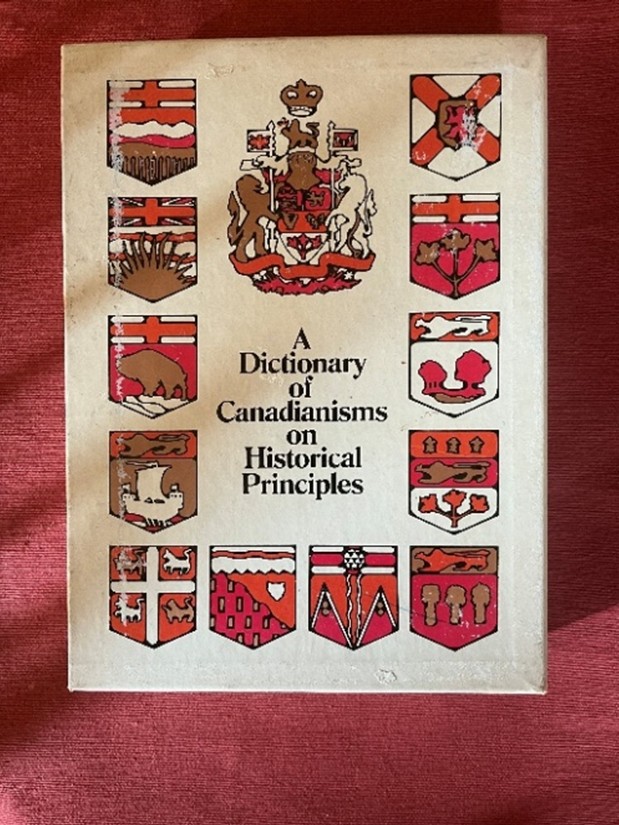
A Dictionary of Canadianisms on Historical Principles (1967)
This landmark Canadian dictionary demonstrated “that a substantial vocabulary relating to both today and yesterday has been developed by Canadians.” The Canadian Dictionary series that evolved from this critical work contained “clues to the true nature of our Canadian identity.” These Canadian dictionaries were a very bold idea for a country that had only recently begun to consider itself a nation in its own right.
The result, despite all monetary constraints and pre-computer editing techniques, was a ground-breaking dictionary: the DCHP-1 was the first scholarly historical dictionary of a variety of English other than British English or American English. This dictionary is an indispensable source from a linguistic point of view and a fascinating treasure of cultural information about Canada’s past and its ever-maturing national identity.
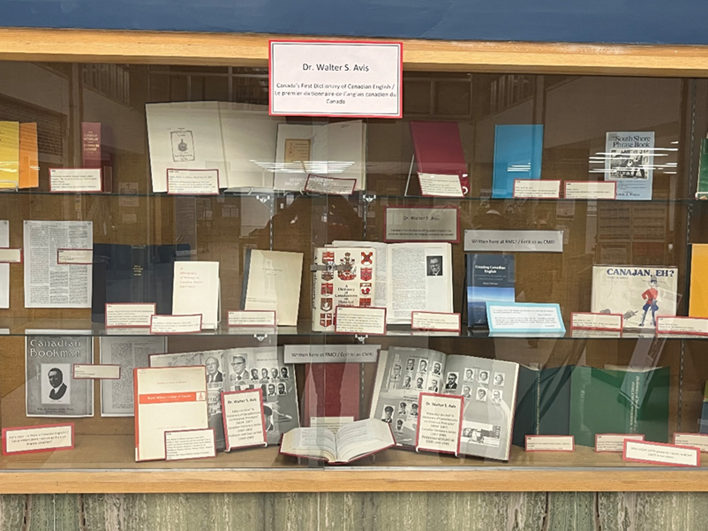
DCHP-1 was republished in open access as of 2013 and is available as a free website, DCHP-1 Online. The second edition (DCHP-2) was edited by Stefan Dollinger (editor-in-chief) and Margery Fee (associate editor) and was published in 2017 as a free-access online dictionary. The Dictionaries and Yearbooks from Dr. Avis’ career have been carefully laid out by Chief Librarian, Sarah Toomey and her staff, in a commemorative display in the entrance of the Massey Library in the fall of 2025.
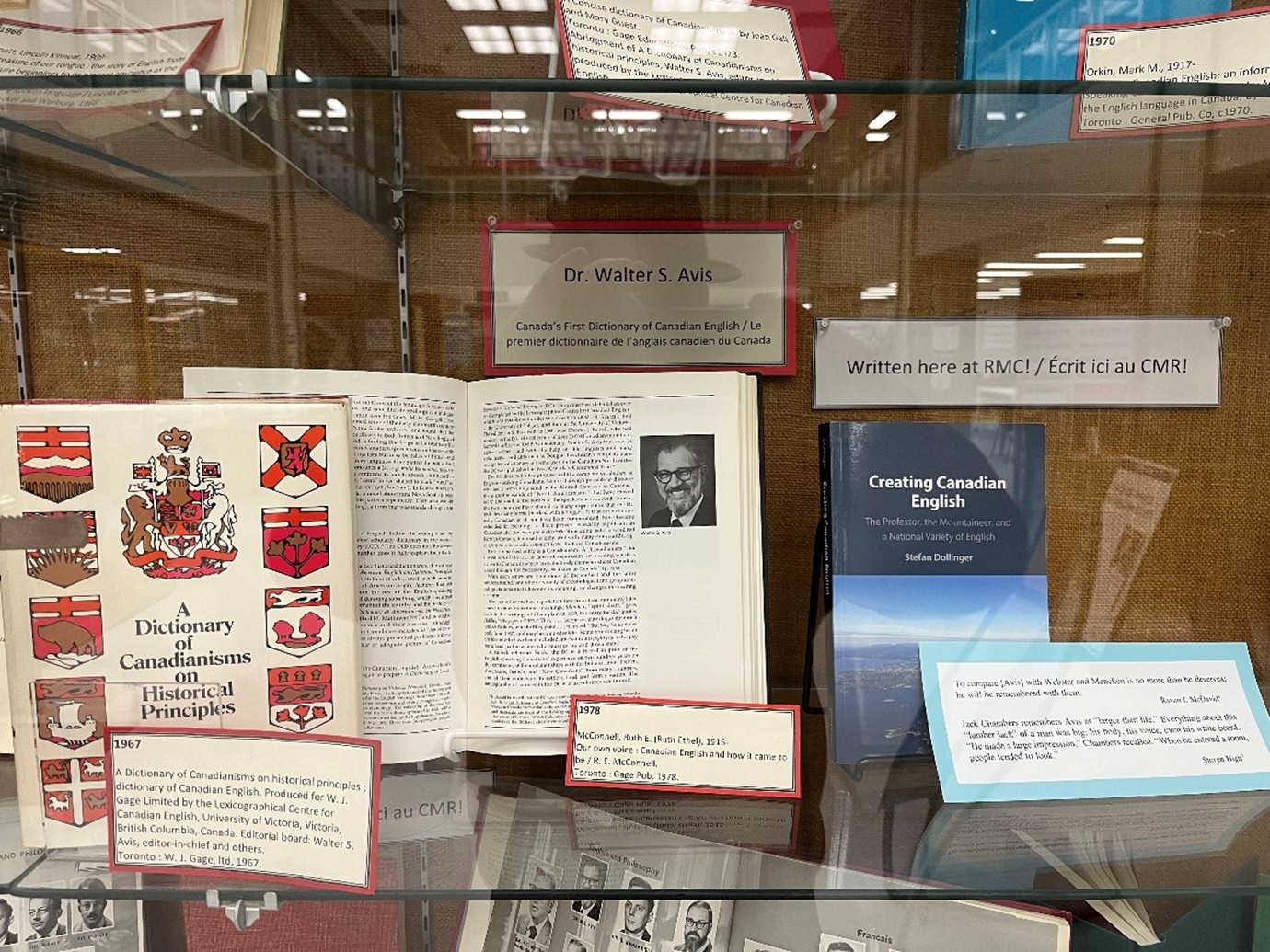
Massey Library Display (2025): Avis’ First Dictionaries of Canadian English
Today, Canadians have many challenges to our security and identity. We need to bolster our efforts to restore national unity and build a more independent, sovereign nation. Mapping our cultural development through Canadian English is part of this important effort. Great support and interest should be focused on the current efforts emanating from current Canadian lexicographers to publish an updated general dictionary of Canadian English, along with a modern, comparative methodology, based on the foundational work of Dr. Avis and his lexicography team that put Canadian English on the chart.
As we approach the 150th Anniversary of RMC in 2026, during a period of nation-building, it is important to make the linkage between Canada’s progress in history and the ofttimes-critical importance that RMC and the military colleges play in making our country stronger. Dr. Avis and the first dictionaries of Canadian English that emanated from RMC are a key part of that story.
-
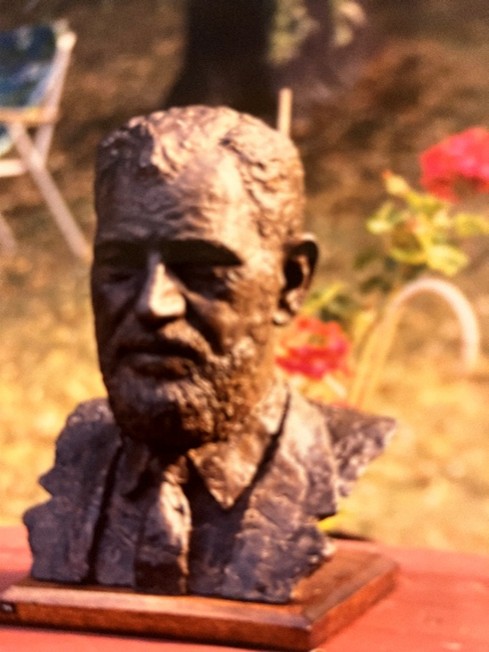
- Dr. W.S. Avis Bust – RMC Museum
-
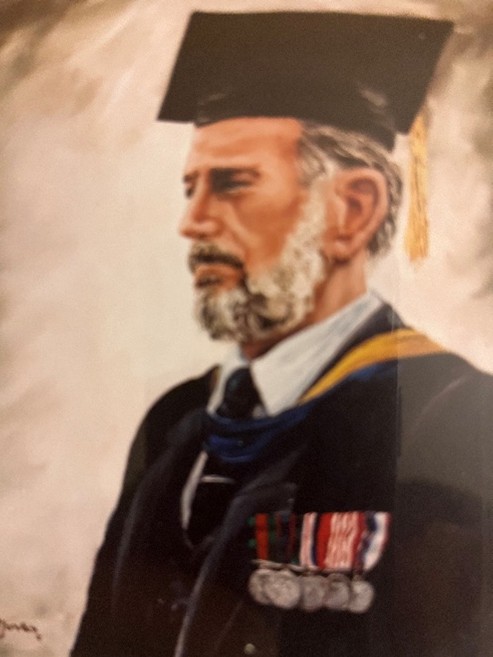
- Dr. W.S. Avis – Painting
-
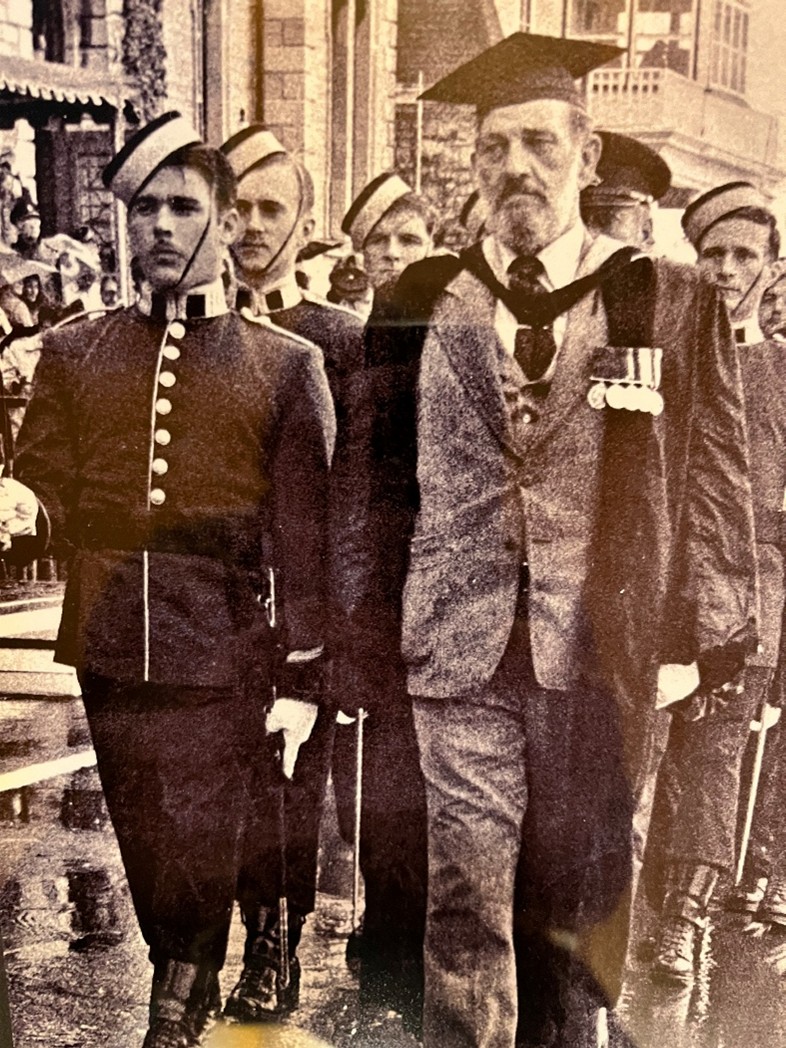
- Dr. Avis and Peter Avis – Graduation 1979