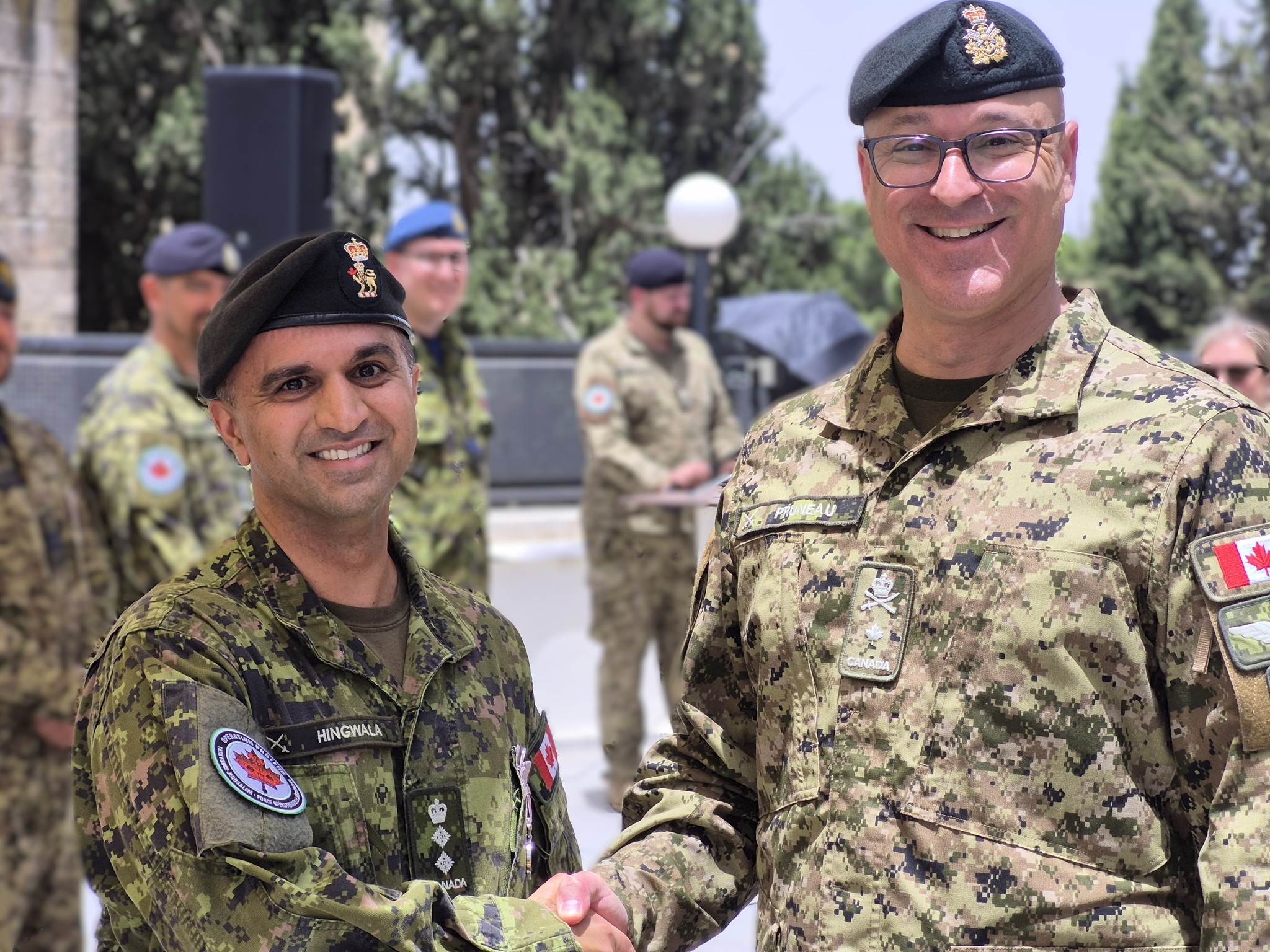
Brigadier-General Frederic Pruneau (Class of 1999), Commander Task Force Jerusalem, promotes Lieutenant-Colonel Chirag Hingwala (Class of 2001) to the rank of Colonel as part of the Operation PROTEUS Honours and Awards ceremony that took place on Canada Day.
Le brigadier-général Frédéric Pruneau, commandant de la Force opérationnelle Jérusalem, a promu le lieutenant-colonel Chirag Hingwala au grade de colonel dans le cadre de la cérémonie de distinctions honorifiques de l’Opération PROTEUS qui s’est tenue lors de la fête du Canada.
Corner Brook Chronicles: From dream to reality — Commander Éric Isabelle (CMR RMC 2007)
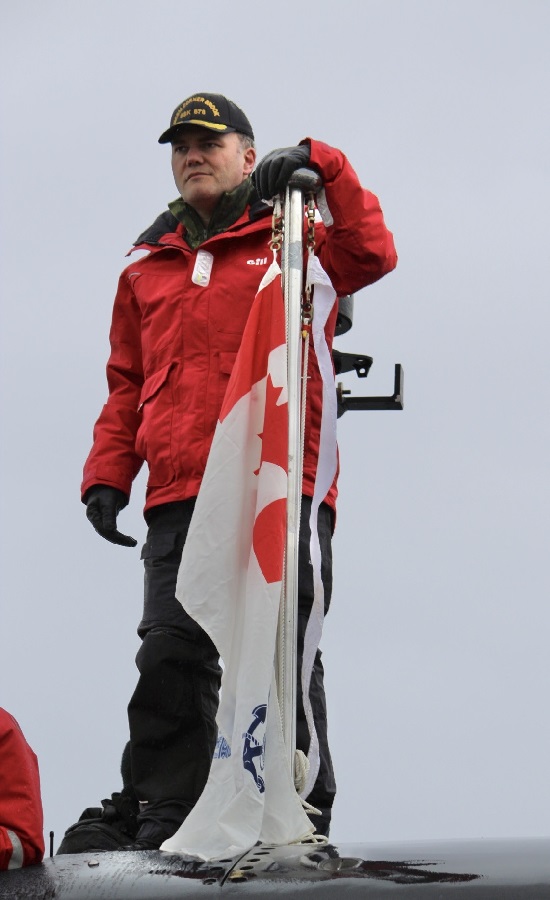 Three years ago, Commander (Cdr) Éric Isabelle, from Montmagny, QC, received his second command, the one of His Majesty’s Canadian Submarine (HMCS) Corner Brook. At the time, the submarine was completing a long period of refit. Now, Cdr Isabelle departs, leaving a fully operational submarine with a crew ready to deploy to serve Canada.
“The submarine has been in refit for a while. We had the time to prepare ourselves and train, and now it’s time for action.”
That enthusiasm comes from a long wait and a desire to accomplish what has always interested him. His father’s family had a lot of experience in the Army, but his father, Gilles, a gunner, had often told Éric that he could see him as a naval officer.
In fact, when he was still quite young, the world of the Navy had already made an impression on him. He even remembers that during a visit to the Musée Maritime du Québec in L’Islet, he made a discovery that would have a major affect on his future.
“My family is really Army but when I saw HMCS Bras d’Or, I was definitely interested. I even told myself that one day I was going to command a ship,” says Cdr Isabelle.
In 2002, he enrolled in the Forces as a Naval Warfare Officer and began his studies at the Royal Military College of Canada. During his time there, he discovered the Canadian Submarine Force and that was it.
“Small teams, the fact that it’s unique, the fact that it’s very independent and the fact that we create our own destiny. You become the commander of a submarine if you put in the time and effort to be able to do the job,” Cdr Isabelle explains.
Canada Day flypast a homecoming for this Snowbirds pilot
https://www.cbc.ca/player/play/video/9.6814673
Capt. Caitie Clapp (RMC 2010) was born in Ottawa and attended the Royal Military College of Canada in Kingston. She’s only the third woman to fly as part of the Canadian Forces Snowbirds.
CAF in the U.S.: Captain Jackie Ruis (RMC 2012), a Chinook Pilot Making an Impact
https://www.linkedin.com/in/kristjan-monaghan-cd-mpa-mds-b5305b1a1/
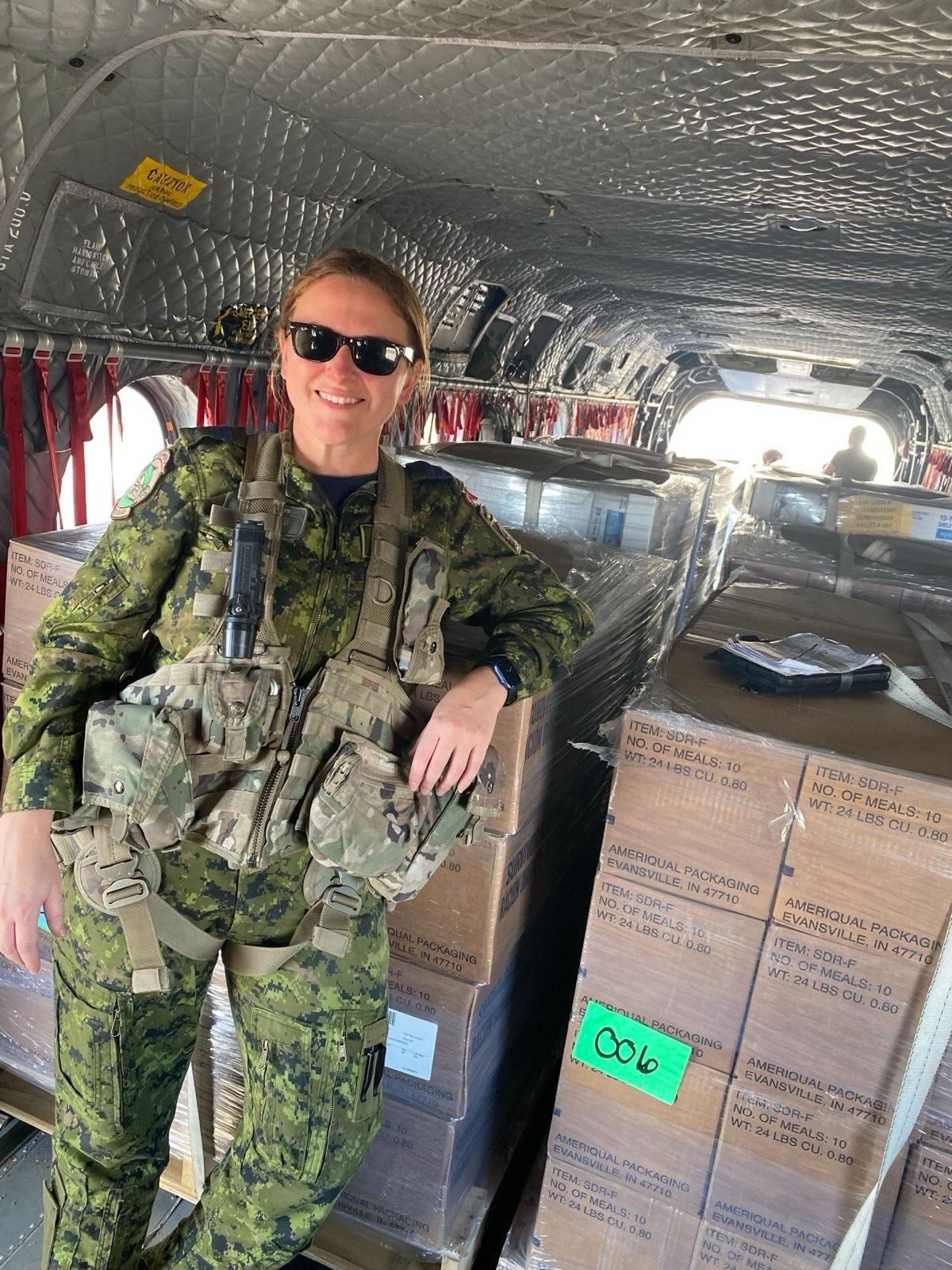 Over 750 Canadian Armed Forces members are currently posted across the United States. Among them is Captain Jackie Ruis, a Chinook pilot from 450 Tactical Helicopter Squadron, based at CFB Petawawa.
Currently serving with Bravo Company, 3 General Support Aviation Battalion, 82nd Airborne Division at Fort Bragg in North Carolina, Jackie is doing great work as part of a close-knit U.S. Army aviation team.
Last year, she deployed to Kuwait and Iraq, flying multi-aircraft missions to transport troops, equipment, and critical supplies. She later took part in post-Hurricane Helene humanitarian efforts, delivering food, water, and heaters to isolated mountain communities in North Carolina, where, as fate would have it, she spent the first five years of her life.
“I realized afterward that I had flown directly over the place I used to live as a child,” she says. “It felt like coming full circle. “It was amazing to be able to help real people in real time,” she adds. “You could see the difference you were making. It felt really good to be part of that.”
Today, Jackie serves as the Executive Officer of Bravo Company and also instructs U.S. Army pilots, bringing Canadian expertise into daily training and operations.
“I love instructing,” she says. “There’s nothing better than seeing a student click with a skill, and suddenly they’re flying just as well as you.”
From flying missions in Iraq to helping local communities in NC, Jackie is representing Canada with the kind of quiet professionalism that gets the job done, and done well.
We’re proud of the work she’s doing, and of the strong, day-to-day partnerships that underpin our defence cooperation.
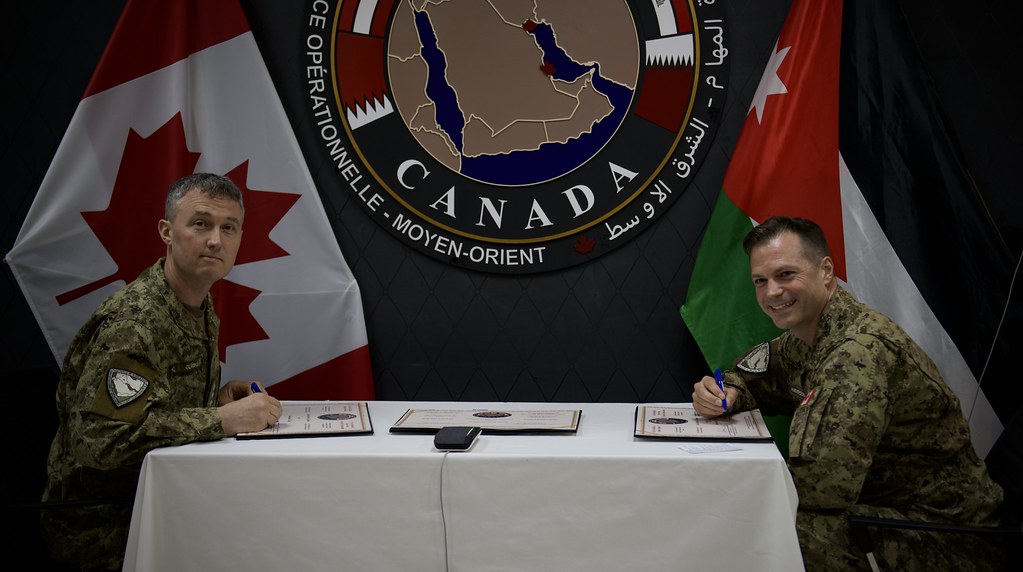
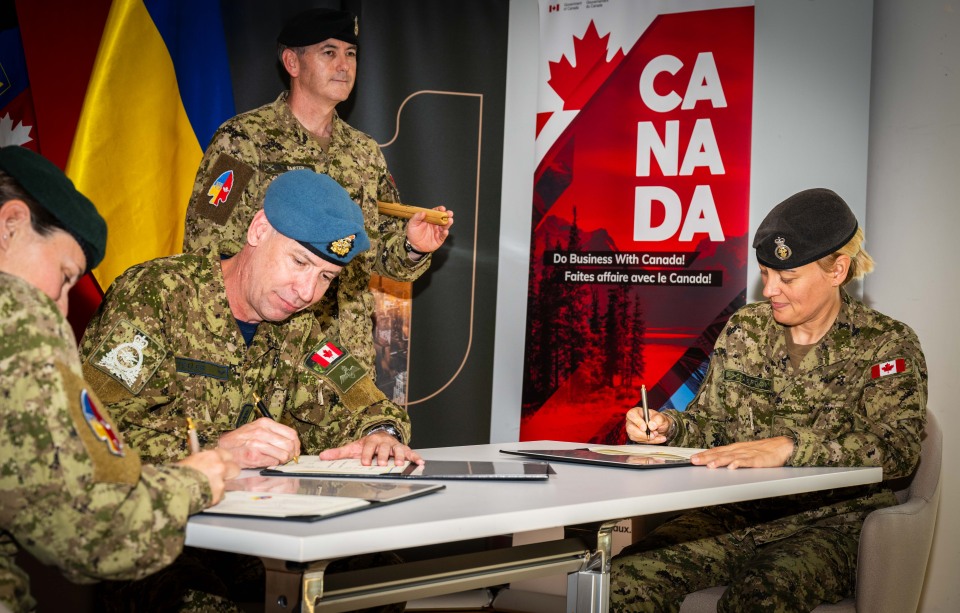
On July 18, #OpAMARNA Task Force Middle East (TF-ME) held a change of command between outgoing Commander Colonel Andrew Anderson (RMC 2002) and incoming Commander Colonel Daniel Clarke, in a ceremony chaired remotely by Deputy Commander of CJOC MGen Timothy Arsenault. TF-ME oversees exercises and defence diplomacy with regional partners, continued support to NATO Mission Iraq, continued capacity building in Jordan and Lebanon, and contributions to the Combined Maritime Force.
Recently, #OpUNIFIER held a Transfer of Command Authority from outgoing Commander, LCol Desroches (RMC 2003), to incoming Commander, LCol Braybrook (RMC 2004). Outgoing Task Force Sergeant Major, CWO Ouellet, handed over his role to incoming Task Force Sergeant Major, CWO Barter. The #CAF continues to support Ukraine with training and donations under Op UNIFIER across Europe. #StrongerTogether
Day in the life of the Kings Guard
Gloves Off Podcast
For most countries, the military is key to national identity. But Canada’s identity has been tied to military contributions to the global order and peacekeeping. Now that’s all changed. The world is heating. The North is thawing. The South is melting. How do we defend Canada and not get overtaken?
Stephen Marche heads to the Arctic with Canadian Ranger Neil Kigutaq and speaks with Retired Major General Scott Clancy and Finnish security expert Matti Pesu about how Canada can build up its military and what a whole-of-society defence approach looks like. With military apathy at home and growing instability abroad, it’s time to ask: What will it take for Canadians to finally take our defence seriously?
Featuring (in order of appearance): MCpl Neil Kigutaq, Major General (ret) Scott Clancy (CMR 1989)& Matti Pesu
Digital Imagery Pioneers Were Also Sailors
https://www.defense.gov/News/Feature-Stories/Story/Article/4237006/digital-imagery-pioneers-were-also-sailors/
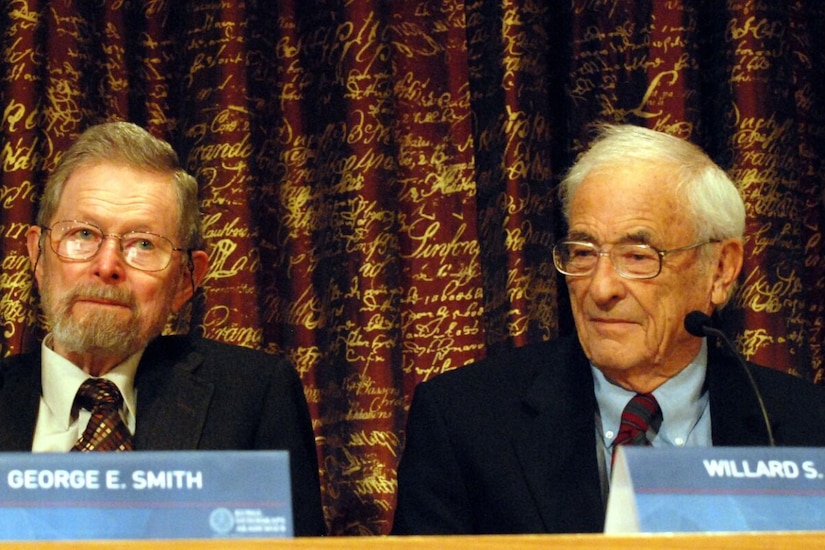
CCDs are at the core of many technologies, including X-ray machines, digital cameras, scanners, image-guided surgeries, smartphones and deep-space telescopes.
Ironically, Smith and Boyle were working on semiconductor integrated circuits for a research and development company in Murray Hill, New Jersey, trying to create improved memory storage for computers when they came up with the idea for the CCD in less than one hour of brainstorming.
Smith served in the Navy from 1948 to 1952. He was an aerographer’s mate, which is a weatherman.
Because he was a Korean War-era veteran, Smith used the GI Bill to attend the University of Pennsylvania, where he majored in physics.
After earning a doctoral degree from the University of Chicago in 1959, he went to work as a researcher and worked for the same development company until he retired in 1986.
Smith, who was born May 10, 1930, in White Plains, New York, died May 28, 2025, in Waretown, New Jersey, at the age of 95.
Boyle served in the Royal Canadian Navy from 1943 to the end of World War II. He was an aircraft carrier-based Supermarine Spitfire pilot.
After earning his doctorate in 1950 from McGill University in Montreal, Boyle taught physics for two years at the Royal Military College of Canada in Kingston, Ontario.
In 1953, Boyle joined the development company where he and Don Nelson invented the first continuously operating ruby laser in 1962. The laser was used for a time by the military for rangefinders and for laser medicine. He also provided support for the NASA Apollo program, helping to select lunar landing sites.
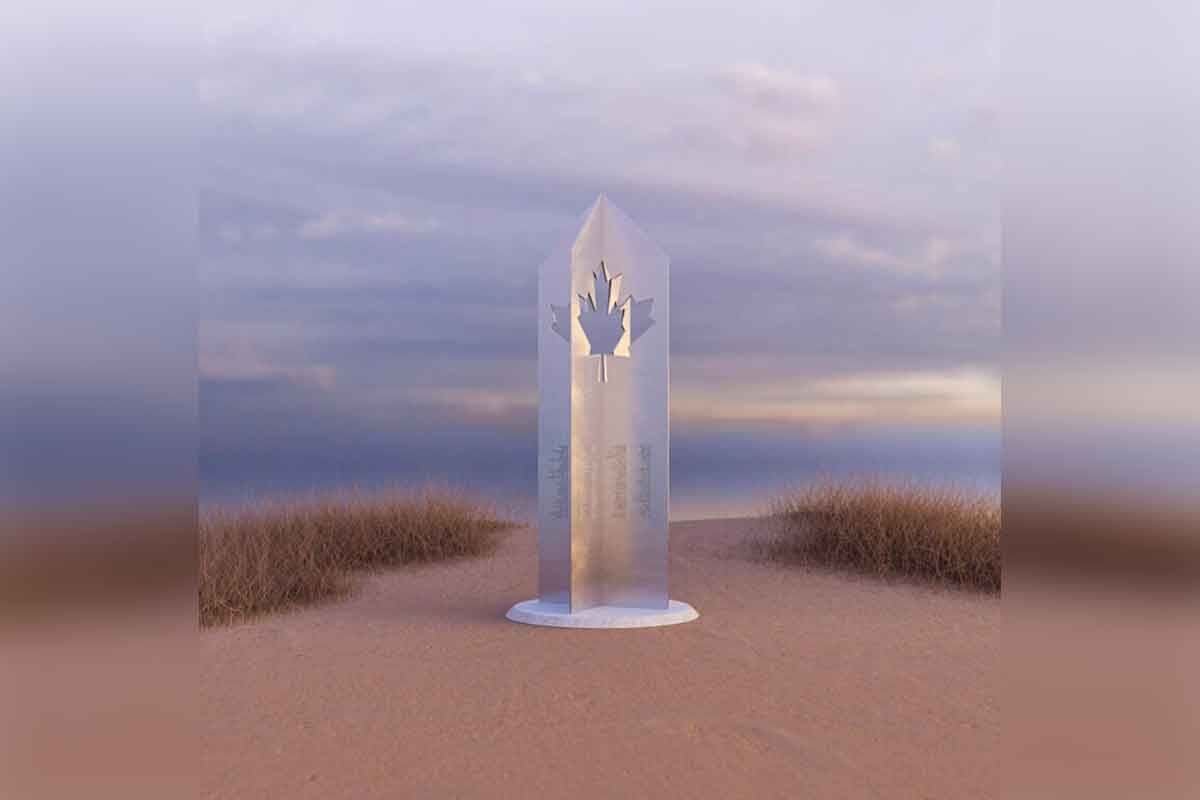
Together, Canso Investment Counsel Ltd. and Lysander Funds Limited made a matching gift in support of a new D-Day monument to be erected on Juno Beach in France. Juno Beach represents a crucial moment in World War II and a significant contribution by Canadian forces to the Allied victory.
This new permanent tribute at Centre Juno Beach – Juno Beach Centre, will, for the first time, list the names of all 381 soldiers and aircrew killed in the Allied invasion of Normandy. Preserving this history for future generations is important to all of us at Canso and Lysander.
To learn more about the Juno Beach project, please visit: https://lnkd.in/e22_pwBR
Cathy Priestman (RRMC 1992) a reçu la prestigieuse Médaille de couronnement du Roi en reconnaissance de sa contribution exceptionnelle au service des anciens combattants, des familles des militaires et bien entendu des vétéranes.
Cathy, qui est un maillon essentiel de la croissance et du succès du Pepper Pod, a reçu la médaille des mains de John Williamson, député de Saint John–St. Croix, au Nouveau-Brunswick, lors d’une cérémonie soulignant son dévouement sans faille.
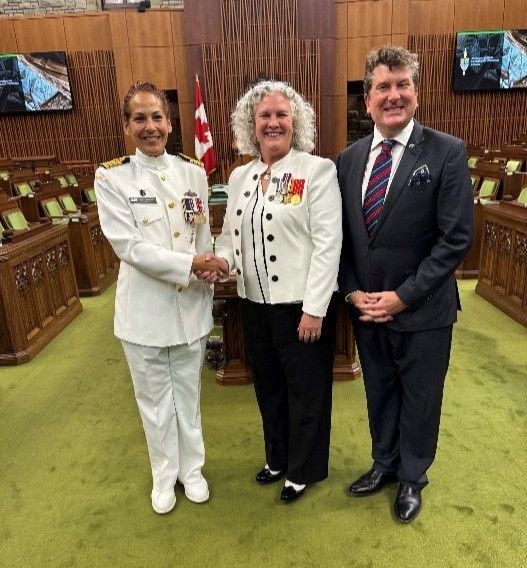
Our very own Cathy Priestman, one of the driving forces behind the growth and success of The Pepper Pod, has been awarded the prestigious King’s Coronation Medal in recognition of her outstanding contributions to veterans, military families, and the broader veteran community.
The medal was presented by John Williamson, MP, Member of Parliament for Saint John–St. Croix, New Brunswick, in a ceremony that highlighted her unwavering dedication to service.
What Canada can learn from Australia on adequately protecting citizens at live events
Authored by Sean Spence, Security Risk Management Practioner and Researcher, RMC
 In April 2025, a man drove an SUV through a crowd of people attending a Filipino cultural festival in Vancouver, killing 11 people and injuring dozens more. In response, the British Columbia government immediately commissioned an inquiry to examine the systemic causes of the incident and whether any lessons could be learned from the tragedy.
The commission came up with six recommendations based on gaps in the current municipal application and approval system for public events across the province.
One key recommendation was that all public events should be required to complete a risk assessment. This isn’t currently happening across the province. The absence of such analysis poses a risk for public safety.
Another recommendation was the creation of local knowledge capacity to support event organizers, particularly for small and rural events, where the expertise to conduct a basic security risk assessment is lacking.
As I argued in August 2022, the live events industry lacks the same level of professionalism as other occupations. Many of these small event organizers are amateurs who lack the resources to properly deal with the security risks involved in holding their events.
Network of Vietnamese scientists, experts in Canada makes debut
https://vietnam.vnanet.vn/english/tin-tuc/network-of-vietnamese-scientists-experts-in-canada-makes-debut-401264.html
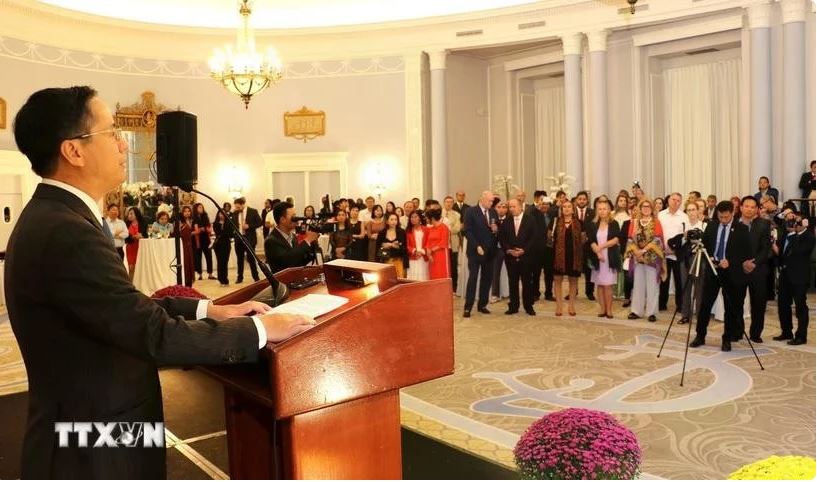 The Canadian Vietnamese Scholars and Experts Network (CVSE) has been launched in an effort to mobilise the knowledge and expertise of overseas Vietnamese communities, particularly in science and technology, to support national development.
The CVSE launch aligns with the Politburo’s Resolution No. 57 on breakthroughs in science, technology, innovation, and national digital transformation. The network brings together individuals who have already established strong reputations in their second homeland through contributions to science, technology, and innovation—fields identified as key drivers for Vietnam’s economic transformation.
Chief Representative for Science and Technology at the Vietnamese Embassy Hoang Ngoc Dinh said that this network will help update Vietnam with cutting-edge scientific knowledge, fostering greater alignment with the country’s strategic development directions.
Canada is currently home to an estimated 300,000 Vietnamese nationals, many of whom are highly educated scientists, entrepreneurs, and professionals. Their expertise and technological know-how are considered crucial for Vietnam as it pursues rapid and sustainable development.
Ambassador Pham Vinh Quang highlighted the importance of the network as a tangible outcome of the Vietnamese Government’s Resolution 169 on overseas Vietnamese affairs and, more specifically, as a concrete step toward implementing the Politburo’s Resolution 57.
Associate Professor Vu Viet Hung from the Royal Military College of Canada, and a member of the CVSE Executive Board, noted that the network’s first principle is to create a forum that fosters meaningful exchanges between scientists from both countries. He stressed the importance of leveraging Canada’s pioneering technological directions for Vietnam’s economic and scientific development.
Former military college graduates to gather for 30-year reunion in Colwood
The largest and last graduating class of the former Royal Roads Military College (RRMC) will be gathering at Royal Roads University from Sept. 12 to 14 to celebrate three decades since their 1995 graduation.
The class of 1995 had 64 graduates before the school’s closure the same year. These graduates went on to lead the Canadian Armed Forces (CAF) operations over the next decades in places like the Persian Gulf, East Timor, Haiti, Bosnia and Kosovo, Afghanistan and at home for floods in Manitoba, storms in Ontario and
Quebec, wildfires in B.C., the 2010 Olympics and multiple G7/8 conferences.
“So 11 out of 64 are still serving. And we’ve got one general, one admiral, so we got guys that made it to the top of the game,” said Kael Rennie (RRMC 1995), a member of the reunion committee, which has been working for the past year to put the event together.