
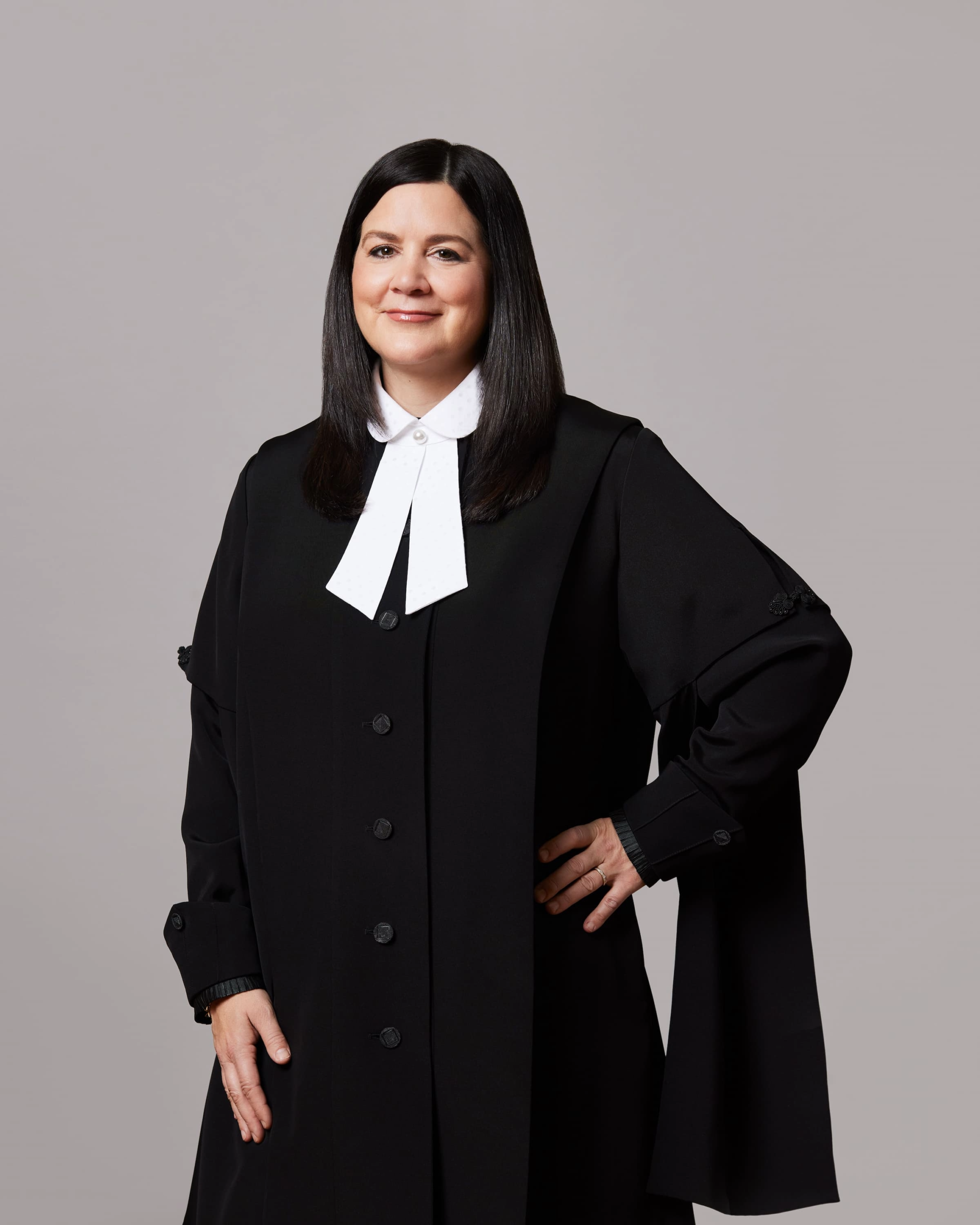
Honourable Michelle O’Bonsawin – honoris causa
The Honourable Michelle O’Bonsawin was appointed to the Supreme Court of Canada on September 1, 2022. She served as a justice of the Ontario Superior Court of Justice in Ottawa from 2017 to 2022.
Prior to her appointment, Justice O’Bonsawin was General Counsel for the Royal Ottawa Health Care Group for 8 years. In this role, she developed a thorough understanding of legal issues related to mental health and performed significant research regarding the use of Indigenous sentencing principles stemming from R. v. Gladue in the forensic mental health system, appearing before various administrative tribunals and levels of courts, including the Human Rights Tribunal of Ontario, the Consent and Capacity Board, the Ontario Review Board, the Ontario Superior Court of Justice, the Ontario Court of Justice, and the Ontario Court of Appeal. She began her legal career with the legal services at the Royal Canadian Mounted Police and was then Counsel with Canada Post, specializing in labour and employment law, human rights, and privacy law.
Justice O’Bonsawin has taught the course Aboriginal People and the Law at the University of Ottawa’s Common Law Program and was previously responsible for the Indigenous Relations Program at the Royal Ottawa Health Care Group. She is a frequent guest speaker on Indigenous sentencing principles, Indigenous issues, as well as mental health, labour, and privacy law. Justice O’Bonsawin is also the author of various publications such as: A Difficult Road to Justice: The Relationship Between Mental Health and Access to Justice in the McGill Law Journal (2024); Access to Justice and Gladue Reports: We All Have a Role to Play in Lawyer’s Daily (2020); A Principled Approach: Applying Gladue Principles at the Ontario Review Board in the National Judicial Institute Indigenous Law Subject Collection (2018); Canada’s Bill C-14 [NCR] A Knee Jerk Reaction to Sensationalized Not Criminally Responsible Cases in the Canadian Criminal Law Review (2016); Mental Health Checklist: A Guide for Members of the Judiciary (2016).
Justice O’Bonsawin currently serves as co-president of the World Assembly of Indigenous Judges and as president of the Canadian Chapter of the World Assembly of Indigenous Judges. She has previously served as a board member of the Canadian Chapter of the International Association of Women Judges, as a member of the Board of Governors of the University of Ottawa, as well as its Executive Committee, and as a Board member for the Aboriginal Legal Services of the University of Ottawa Legal Aid Clinic. She was an observer member of the Membership Committee of Odanak First Nation and a Board member of the Canadian Institute for the Administration of Justice. She was a Partner Judge for Afghanistan Women Judges with the International Association of Women Judges.
Justice O’Bonsawin holds a Bachelor of Arts from Laurentian University, a Bachelor of Law from the University of Ottawa, a Master of Law from Osgoode Hall Law School, and a Doctorate in Law from the University of Ottawa. She is also the recipient of honorary doctorates from Bishop’s University and Laurentian University.
Justice O’Bonsawin grew up in Hanmer, Ontario, a small Francophone town near Sudbury. She is a fluently bilingual Franco-Ontarian and an Abenaki member of the Odanak First Nation.
Remise de doctorat honorifique dans le cadre de l’automne 2026 cérémonie de collation des grades du CMR
L’honorable Michelle O’Bonsawin a été nommée à la Cour suprême du Canada le 1er septembre 2022. Elle a été juge à la Cour supérieure de justice de l’Ontario à Ottawa de 2017 à 2022.
Avant sa nomination, la juge O’Bonsawin a été avocate générale au Groupe des services de santé Royal Ottawa pendant 8 ans. Dans ce rôle, elle a acquis une compréhension approfondie des questions juridiques liées à la santé mentale et a effectué d’importantes recherches sur l’application des principes d’imposition de peine de l’arrêt R. c. Gladue dans le système de santé mentale en contexte judiciaire, comparaissant devant divers tribunaux administratifs et judiciaires, notamment le Tribunal des droits de la personne de l’Ontario, la Commission du consentement et de la capacité, la Commission ontarienne d’examen, la Cour supérieure de justice de l’Ontario, la Cour de justice de l’Ontario et la Cour d’appel de l’Ontario. Elle a commencé sa carrière juridique au sein des services juridiques de la Gendarmerie royale du Canada et a par la suite agi à titre d’avocate à Postes Canada, où elle s’est spécialisée dans les domaines du droit du travail et de l’emploi, des droits de la personne et du droit relatif à la protection de la vie privée.
La juge O’Bonsawin a enseigné le cours Les autochtones et le droit dans le cadre du Programme de common law de l’Université d’Ottawa et a été responsable du Programme des relations autochtones du Groupe des services de santé Royal Ottawa. Elle prononce régulièrement des conférences sur des questions touchant les principes d’imposition de la peine aux personnes autochtones, les enjeux autochtones ainsi que le droit relatif à la santé mentale, au travail et à la protection à la vie privée. La juge O’Bonsawin est également auteure de diverses publications, notamment : A Difficult Road to Justice: The Relationship Between Mental Health and Access to Justice dans la Revue de droit de McGill (2024); Access to Justice and Gladue Reports: We All Have a Role to Play dans Lawyer’s Daily (2020); A Principled Approach: Applying Gladue Principles at the Ontario Review Board dans la Collection sur le droit des Autochtones pour l’Institut national de la magistrature (2018); Canada’s Bill C-14 [NCR] A Knee Jerk Reaction to Sensationalized Not Criminally Responsible Cases dans Canadian Criminal Law Review (2016); Le livret sur la santé mentale : un guide pour les membres du système judiciaire (2016).
La juge O’Bonsawin est actuellement co-présidente de l’Assemblée mondiale des juges autochtones et présidente du Chapitre canadien de l’Assemblée mondiale des juges autochtones. Elle a siégé comme membre du conseil d’administration de la section canadienne de l’Association internationale des femmes juges, membre du Bureau des gouverneurs de l’Université d’Ottawa ainsi qu’à son comité exécutif et a été membre du conseil d’administration des Services juridiques autochtones à la Clinique d’aide juridique de l’Université d’Ottawa. Elle a été membre observatrice du comité d’adhésion de la Première Nation d’Odanak et membre du conseil d’administration de l’Institut canadien d’administration de la justice. Elle a été juge partenaire pour le soutien aux magistrates afghanes auprès de l’Association internationale des femmes juges.
La juge O’Bonsawin détient un baccalauréat ès arts de l’Université Laurentienne, un baccalauréat en droit de l’Université d’Ottawa, une maîtrise en droit de la Osgoode Hall Law School et un doctorat en droit de l’Université d’Ottawa. Elle a également reçu des doctorats honorifiques de l’Université Bishop’s et de l’Université Laurentienne.
La juge O’Bonsawin a grandi à Hanmer, en Ontario, une petite ville francophone près de Sudbury. Elle est une Franco-Ontarienne parfaitement bilingue et elle est membre abénakise de la Première Nation d’Odanak.

