Article submitted by Dr. Walter Dorn, and Erica Wilson
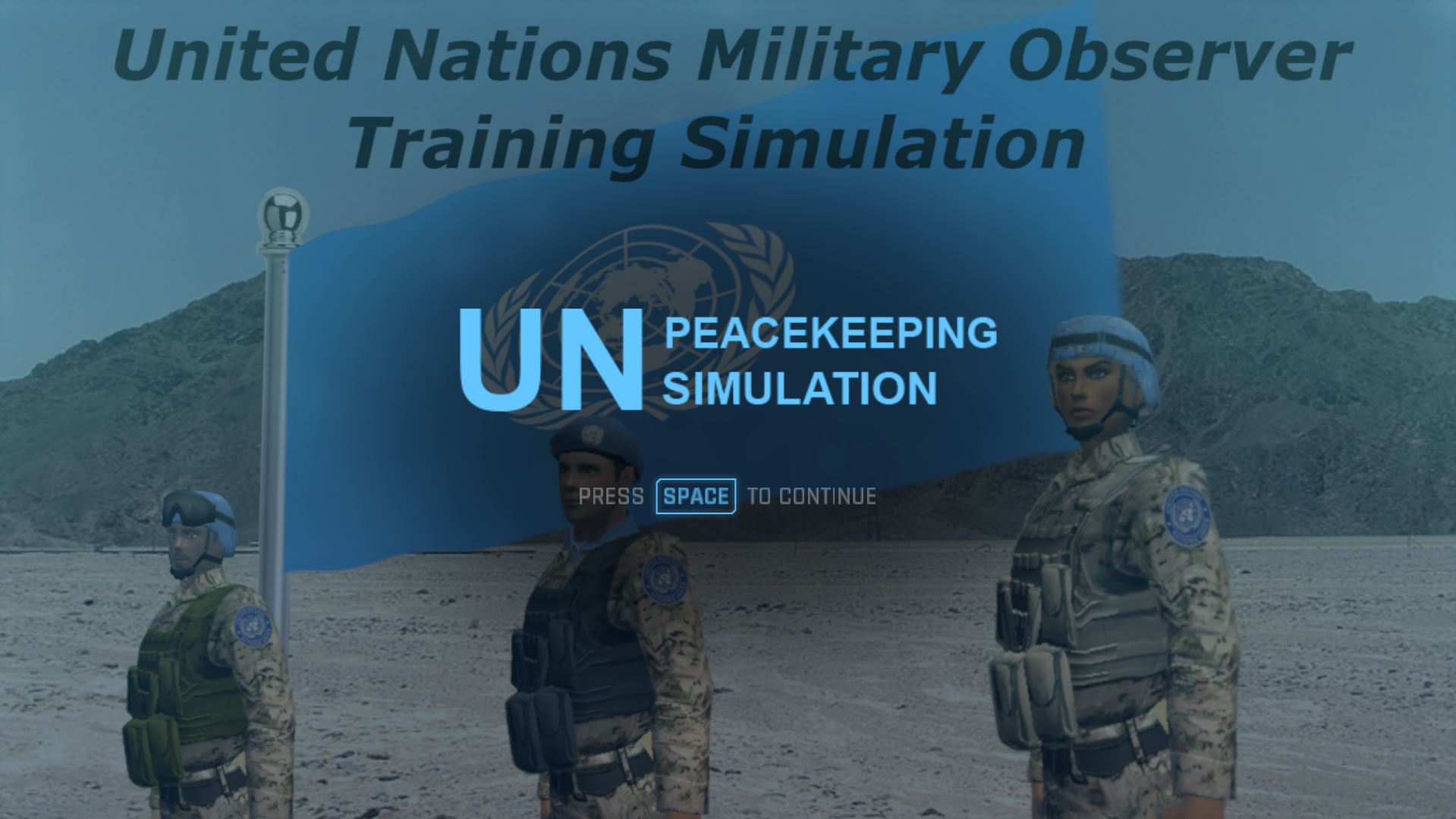
Digital simulations provide an enhanced way for students to learn, by placing them as avatars in scenarios with many options. It has been effectively pioneered in courses at RMC, CFC, and RMC Saint-Jean. Though most students are thoroughly familiar to playing video games, the use of this medium for teach is usually novel to them. Digital Simulations have been tested and used in military training centres in Australia, Bangladesh, Kenya, Nepal, and Uruguay and are also being offered to other nations through the United Nations.
In the Peacekeeping Simulation “Investigating Atrocity” students find themselves in Naraland, where they must deal with a hostile guard at a bridge checkpoint, a shifty village chief, and traumatized villagers who give conflicting stories about an attack two days earlier. In this open world simulation, the player controls an avatar (a peacekeeper) in order to engage in dialogue and actions that promote peace and progress. The player must discover new evidence and try to solve some mysteries behind the attack. Students learn about UN missions and the many challenges of operating in war-zones while trying to be impartial investigators.
The simulation was designed and developed by Professor Walter Dorn (Department of Defence Studies at RMC and CFC). He is an operational professor who has served in UN missions and regularly visited them for over 20 years. Six years ago, during a sabbatical, he started exploring the new medium of digital simulation. He wanted to offer scenario-based learning to students in his courses on peace operations. To develop digital simulations, he created a team of a dozen researchers and developers who looked at UN operations and identified important lessons before gamifying them through the Unity Game Engine. A website is devoted to the project: https://www.peacekeepingsim.net.
The UN’s Department of Peace Operations provided Dr. Dorn with a Table-top exercise (TTX) for the Naraland scenarios that his team used to create the first version of the Peacekeeping Simulation. The United Nations in New York and UN peacekeeping missions in the field are considering the use of Dorn’s digital simulations for training, both pre-deployment and in-mission.
The RMC Alumni Association is providing funds to develop the simulation so it can be used in RMC courses (pending necessary authorizations). In addition, the Collège Militaire Royale Saint Jean (CMR) has requested a module that deals with climate change and conflict. So, the same peacekeeping avatar must soon deal with flash floods and the problems of providing potable water to the local population living in a polluted water zone around internally displaced persons (IDP) camps.
The scope for exploring digital simulations is vast, with new modules envisioned that will deal with an impending attack on a village, where peacekeepers need to become peace enforcers in order to protect villages and prevent the attack. Future modules are also expected to deal with the difficult issues of sexual exploitation and abuse (SEA) and conflict-related sexual violence (CRSV).
To learn more about this project click here: https://www.peacekeepingsim.net/about-us/