
Submitted by Cam Carbert RMC 1975 , Vice-President/Director of Communications
RMC Alumni Association – Kingston Branch
BACKGROUND
This document, entitled “Royal Military College of Canada Social Training”, was probably written about 1930. This version is from a “handout” issued sometime between 1970 and 1975. The original had been typed on 8 ½” x 14” paper and then photocopied multiple times for distribution over the years. A page explaining table setting was actually printed by hand and attached as the last page. The information on this page has been typed up and inserted into appropriate locations within the main document. The original place setting sketches have been used.
It seems plausible that the original version was written in the 1930s as the word “Jalopy” is used several times. “Jalopy”, meaning a decrepit car, was first used in 1928 and went out of favour around 1941.
The document was obviously amended post WW2 when RMC cadets’ military rank became “Officer Cadet”. However, the rank of “Gentleman Cadet” still appears twice in the document. To update the content somewhat, the names Capt Marvel and Sgt Rock were used. Capt Marvel first appeared in comics in 1940, while Sgt Rock comics were first published in 1959.
ROYAL MILITARY COLLEGE OF CANADA
SOCIAL TRAINING
When in the public eye, an Officer Cadet will inevitably be judged by his appearance and manners, thus the social aspect of training at RMC needs special emphasis. Even if a cadet happens to be an honours student or an outstanding athlete, poor manners and a slovenly appearance will almost certainly colour the impression which he conveys to people.
If a cadet is to be worthy of the appellation of “Gentlemen Cadet,” he should aspire to the characteristics outlined by the Philosopher Amiel:
“The gentlemen, then, is the man who is a master of himself, and makes others respect him. The essence of gentlemanliness is self-rule… From self-respect a thousand other things are derived — such as the care of a man’s person, of his language, of his mariners; watchfulness over his body and over his soul; dominion over his instincts and his passions; the effort to be self-sufficient; the pride which will accept no favours; carefulness not to expose himself to any humiliation or mortification, and to maintain himself independent of any human caprice; the constant protection of his Honour and his Self-Respect.
In order to lay himself open to no reproach, a gentleman will keep himself irreproachable; in order to be treated with consideration, he will always be careful himself to observe distance, to apportion respect, and to observe all the gradations of conventional politeness, according to rank, age and situation… ”
It would indeed be difficult to live up to the code of Amiel, however, a cadet cannot help but improve himself in the attempt. All cadets should keep this goal in mind when applying the rules outlined in this precis to the various social situations which may be encountered.
SOCIAL FUNCTIONS – GENERAL
The “Golden Rule” of etiquette is quite simple and easily remembered – be as inconspicuous as possible. Breaches of etiquette are more likely to be noticed if you are loud and active, so do not attract undue attention to yourself. A corollary to the Golden Rule is that if you are unsure whether or not a certain action is in good taste, watch the host or hostess. If the host or hostess does something, then the odds are that the act is perfectly acceptable. But remember – you can’t fake it if you are the centre of attraction.
INVITATIONS
Most social functions involve the sending of invitations and some form of reply. With the exception of official invitations, the task of sending invitations rests with women. For this reason, this section will mainly be concerned with the acceptance of invitations.
The following example should be sufficient to enable you to send an official invitation in the correct form:
OFFICER CADET CASIMIR DUMBROWSKI
REQUESTS THE PLEASURE OF THE COMPANY OF
CAPTAIN ALBERT MARVEL C.D.
AT A SHOT-GUN WEDDING ON FRIDAY
THE THIRTEENTH OF OCTOBER
AT EIGHT O’CLOCK
R.S.V.P.
OFFICER CADET CASIMIR DUMBROWSKI
STONE FRIGATE
ROYAL MILITARY COLLEGE
KINGSTON, ONTARIO
Note that the invitation is written in the third person, and that any decorations, honours, etc., which the guest may have are included with his name. If the spouse is to be invited as well, decorations are not included, as in the following example: “Sergeant and Mrs. Rock”.
Formal invitations are usually printed or engraved, and always include an R.S.V.P. (Repondez s’il vous plait – please reply). All numbers are written out, and the only acceptable abbreviations are Mr., Mrs., or o’clock. The R.S.V.P. includes the address of the person sending the invitation.
The reply should be in the following form:
CAPTAIN ALBERT MARVEL
ACCEPTS WITH PLEASURE THE KIND INVITATION
OF OFFICER CADET CASIMIR DUMBROWSKI
TO A SHOT-GUN WEDDING ON FRIDAY
THE THIRTEENTH OF OCTOBER
AT EIGHT O’CLOCK
Similarly, the regretting of an official invitation follows the same format:
CAPTAIN ALBERT MARVEL
REGRETS THAT HE WILL BE UNABLE
TO ACCEPT THE VERY KIND INVITATION
OF OFFICER CADET CASIMIR DUMBROWSKI
FOR
FRIDAY THE THIRTEENTH OF OCTOBER
AT EIGHT O’CLOCK
Note that the reply follows the same format as the invitation and also is written in the third person. The person replying does not include his decorations, honours, etc., in his reply. Replies can be written in long-hand or typed. Regrets follow the same rules, but may exclude the nature of the function for the sake of brevity.
In the case of informal invitations, replies or regrets should be sent in the same form as the original invitation – if the original came by mail reply with a letter; if by telephone, reply by telephone.
VISITS
Invitations for weekend visits are not uncommon for Officer Cadets, and in the case where the invitation comes from the parents of a friend or a new acquaintance, the reply should be sent by letter. Be sure to include an indication of the time of arrival and method of transportation as a convenience to the host or hostess. Regretting is also by letter and should at the very least include an explanation of the reason for refusing. You also must thank the host or hostess for the invitation.
INTRODUCTIONS
Most social functions present the opportunity to make new acquaintances; indeed, if you are conducting yourself properly you will be circulating amongst the guests and not clinging to old cronies of long association. This makes it mandatory that cadets know the correct forms of introduction. The following points apply when making introductions:
- A gentleman is always introduced to a lady.
- b) A single woman to a married woman.
- c) A young man to an older man.
- d) A junior to a senior.
The most likely occurrence finds two Officer Cadets, both handcuffed to blind dates of a sadist’s choosing, faced with the dilemma of introductions.
Given: Officer Cadet A and Stab A
Officer Cadet B and Stab B
Required: Introduce everyone without incurring the wrath of the CWRO.
Solution: Officer Cadet A introduces girl A to Officer Cadet B.
Officer Cadet B then introduces girl B to both girl A and Officer Cadet A.
During introductions both parties remark, “How do you do.” It is incorrect to reply with any remark as to one’s health such as “I’m suffering with bubonic plague, or worse still, to express pleasure at meeting the person.
The last point to keep in mind during introductions is to remember the names of people introduced to you so as to avoid making a buffoon of yourself later.
DANCES AND FORMAL BALLS
When attending a dance, and especially at a Ball, the Golden Rule of remaining inconspicuous applies. Wild or suggestive dancing is a nein-nein, since it may embarrass other people and could possibly result in casualties on the dance floor. And lastly, over-exertion could cause your deodorant to fail miserably. Similarly, drunkenness is to be avoided at all costs.
Such occasions usually invite relaxation of standards of dress, and this is definitely frowned upon. It is acceptable to unbutton one’s blazer, but under no circumstances should the tie be loosened. Hair has a tendency to do its own thing at these affairs, but under no circumstances is it permissible to comb it in public.
At Formal Balls, Officer Cadets are expected to be at their best behaviour. The following should be kept in mind when attending a ball:
- When inviting a date to a formal ball you should allow her at least two weeks to select a dress, etc. Let her know about parties before or after such affairs. Don’t be cheap when it comes to transportation. Formal wear and jalopies, motorcycles, etc., definitely clash.
- You must go through the receiving line. Both you and your date wear gloves when going through the receiving line, and the lady precedes her escort. Gloves may be removed once you have left the receiving line, but they should not be draped over the white belt.
- Under no circumstances should the collar of the tunic be undone, nor should buttons be opened.
- Do not hold hands with your date. Instead, you should walk arm-in-arm.
- When the buffet meal is served, wait until the Commanding Officer arrives at the serving area before proceeding. Your date should walk ahead of you.
COCKTAILS
A cocktail is usually held in the late afternoon or early evening, and may precede another function, such as a. ball. The object is to meet people, so circulate! Upon arriving, you should seek out the host or hostess and pay your respects. Men usually stand at cocktails whereas ladies may be seated. Remember to serve your date before indulging yourself. As mentioned, a cocktail may take place before another function, so control your intake of alcohol. Being carried out of a cocktail is no longer fashionable, even for incurable romantics. If Hors d’ouevres or sandwiches are served they should be taken in small quantities at any one time. Abide by the time limit indicated on the invitation and make your move to leave on time. If dress is not specified, wear a dark suit. Always thank the hosts before leaving.
TEAS
Teas usually take place in lieu of a cocktail, and thus the same rules apply. Garden parties are in essence outdoor teas or cocktails. Avoid littering at such affairs, and return cups, saucers, and glasses to the tables provided.
DEPORTMENT IN PUBLIC
Once again, the rule-of-thumb for an Officer Cadet in public is to avoid the spotlight. This is difficult since a dashing young man in uniform is bound to attract attention, so you must be at your best.
PUBLIC PLACES
Notwithstanding establishments which have been declared out-of-bounds, Officer Cadets (especially in uniform) should avoid shoddy establishments.
THEATERS
If an usher is present, allow your date to go ahead of you and choose the seats. If there is no usher available, ask her where she would like to sit and then you lead the way. Never let her take the aisle seat (this also applies on buses, trains, etc.).
RESTAURANTS
If a head-waiter is present, he will conduct your date to a table, with you following close behind. If there is no head-waiter, you lead the way.
TRAVELLING
If on foot, you should walk in a dignified manner, and avoid window-shopping or loitering. If walking with a lady or ladies, you walk on the curb side. Remember to help your date onto buses or into automobiles. Do not hold hands in public and avoid outward marks of affection. You may walk arm-in-arm.
When on a bus or train, be the first to offer your seat to a lady or elderly person. Try not to carry bulky parcels or baggage over great distances – use a porter if at all possible.
OTHER POINTS TO REMEMBER
- Never use a toothpick or chew gum in public.
- Never groom your hair or manicure your nails in public.
- When in a group, walk two abreast.
WHEN IN UNIFORM
- Salute all memorials.
- Salute the hearse in funeral processions (it is not necessary to stop walking).
- Salute when the national anthem is being played – if you are not wearing headdress, put it on, then salute.
- Salute ladies of acquaintance.
- Salute other cadets with guests or dates. When you have guests or a date you return the salute.
DINING
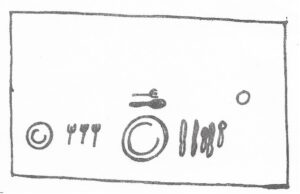
Knives, forks and spoons correspond to the courses and are placed in order in which they will be used. On the right of the plate, starting from the outermost pieces, will be found the soup spoon (bread and knife and teaspoon may appear after the soup spoon or above the main course plate, fish knife, and dinner knife. On the left of the plate going inward one finds the fish fork, salad fork, and dinner fork. The dessert fork and spoon usually appear above the plate.
Place Setting Before Meal
The prime directive in table manners is to avoid making other people at the table nauseous. Rules of etiquette may vary from place to place, but the ones outlined in this section are widely accepted and should stand you in good stead. Remember that good posture is essential and if you are sitting properly with your back erect, there will be less temptation to put your elbows on the table.
- Be sure to help your guests into their seats before sitting down.
- The napkin belongs in your lap as soon as you sit down.
- Outside of regular college meals it is customary to wait until the host has begun to eat before starting yourself.
- Bread or rolls are always to be taken from the plate, placed on your side plate and either broken or cut, and then buttered on the plate. Similarly, the butter is transferred from the butter plate to your side plate using the butter knife. Then your own knife is used to spread the butter.
- When eating soup move the spoon away from you. The last portions can be finished by tipping the plate away from you.
- Do not put condiments on your main dish until you have first tasted the food. It is an insult to the host’s cooking otherwise. Try not to make a big show of shaking salt or pepper on your food. Like every other movement at the table, it should be done in moderation. Parsley is put on the plate to be eaten. If you don’t like it leave it on the edge of your plate. If you do like it, eat it with your fingers.
- The main course is eaten with knife and fork. The fork is in the left hand and the knife in the right through the whole meal. One may place the knife down and continue to eat with the fork in the LEFT hand reversing its position (tines up) so it may be used as a shovel. Don’t combine the shovel with the knife. It is very poor taste to scrape your knife on your fork.
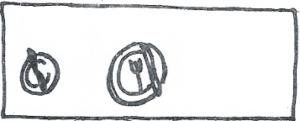
- When passing something to a companion, you have to stop eating and place both knife and fork (tines down) are placed on the edge of the plate at the “five o’clock” position. The bread knife is left in a similar position on the side plate when not in use. The hand not doing the passing is placed in your lap.
- When a course is completed, utensils are placed in the same position as passing, with the fork (tines up). This signifies to the waitress that you have finished eating. The soup spoon is placed on the right side of the plate.
Position of knife and fork while passing, or after completing a course
- Don’t take a drink unless your mouth is empty and don’t play with or cling to your glass; remember – hands on the table when not necessary show bad manners. Except in certain cases, it should never be necessary to hang on to any of your chinaware.
- The dessert, other than pie and cake, is eaten with a tablespoon in the right hand. The places are set so that one may either use both fork and spoon or just fork for eating pie. Both methods are acceptable.
- Try not to make too much of a business of stirring your tea or coffee.
- When excusing yourself from the table be sure you have finished eating and place your napkin at the edge of your plate.
MISCELLANEOUS
- When not actually eating, both hands and arms should be kept in your lap. While using utensils it is permissible to rest your wrists on the table. The arm lifts the food to the mouth; the head never lowers to an arm resting on the table. Elbows should be kept close to the side.
- To minimize passing back and forth it is good manners to ask your immediate dinner companions if they would like whatever you are helping yourself too. Reaching should be replaced by requests, properly given, to the other members at the table to pass whatever you wish. When asking for something add the person’s name to the request so that everyone won’t be interrupted.
i.e. “Pass the sugar, please, Zeke”
- It is quite right to eat from bones of fowl held in the hand.
- If coffee is served at the table after, the meal, it is often the practice to have a cigarette. Never begin to smoke until your host or hostess does or until she gives her permission. Avoid taking out your own cigarettes.
- A bad habit to get into is playing with your utensils between courses.
- Never use your fingers to push food. If you can’t get it, leave it on your plate.
- Avoid having more than a small mouthful at any time so that there won’t be an embarrassing silence when you are asked a question. Keep your mouth closed when eating and don’t talk with food in your mouth. Finish each mouthful in turn; don’t stuff.
- Toothpicks are never used at the table or in public.
- Should you chew into a piece of gristle or bone, or something similarly grotesque, remove the offending substance from your mouth with a fork and place it on the side of your plate. Never spit unappetizing food on your plate
CONCLUSION
This precis does not presume to be the final word on etiquette, and it is hoped that you will refer to the various books written on the subject or consult with your seniors should a question arise. It is hoped that with intelligent reading and interpretation you will take the first steps to approaching the gentleman characterized by Amiel. Self-discipline is necessary to make good manners a habit, and with conscientious effort on your part you can be a Gentleman Cadet in person as well as in name.
2 Comments
Leave a Comment


This should be given to all Cadets entering the Colleges. This has not changed since the day it was written but the standard has. It has gone down.
This is one of the most interesting articles I have seen in e-Veritas in a long while. It clearly hearkens back to an era when social norms were very different from what is acceptable today.
I remember that when I was a recruit 50 years ago, part of our training involved a requirement to successfully complete a test on etiquette. Back in those days, the Duty CSTO would patrol Yeo Hall during mealtimes, and hand out summary punishments for infractions, whether real or imagined. I remember at least one CSTO who was famous for doing so.
Also interesting to see the comments about smoking. At the time this piece would have originally been written, smoking was considered to be fashionable. No one even remotely imagined the health risks that were involved, and my understanding is that in that era many cadets smoked. I sincerely hope that none of today’s generation of cadets smoke. The class of 1980 lost one of our members to cancer in 2020, he was one of the few that was a regular smoker.