The Alberta Order of Excellence
https://www.alberta.ca/aoe-paul-wynnyk
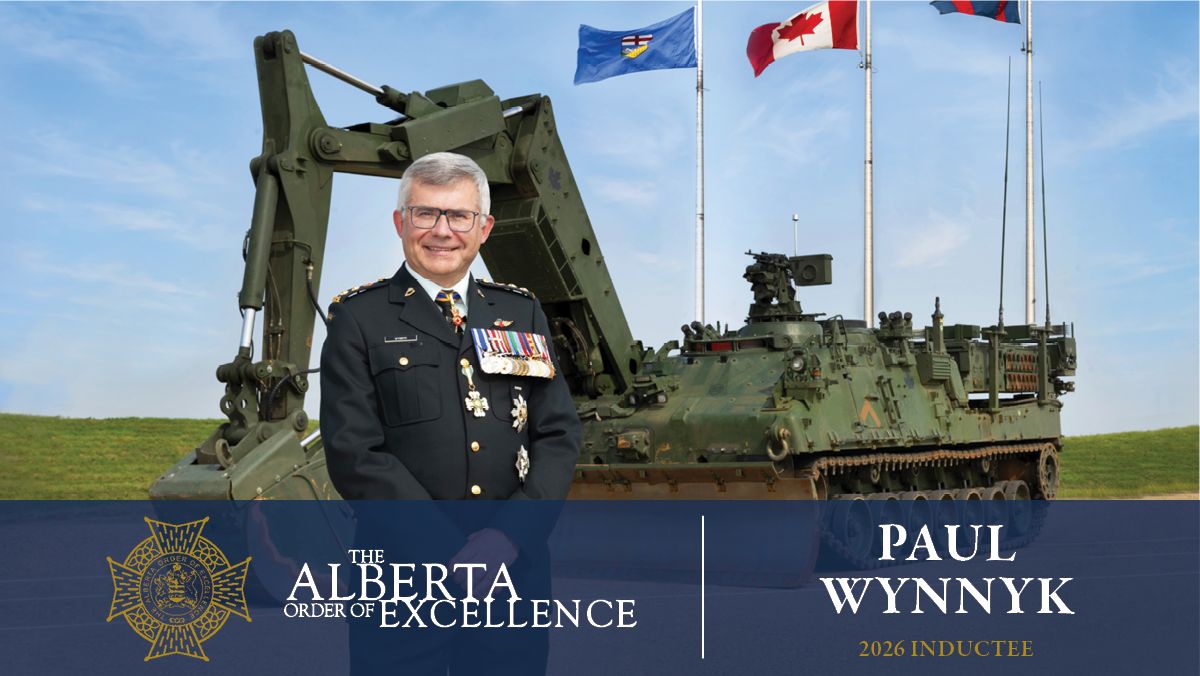
Lieutenant-General (Ret’d) Paul Wynnyk (RRMC RMC 1986) of Sherwood Park served in the Canadian Army for 38 years, retiring in 2019 after rising to vice chief of the defence staff. It was the culmination of a remarkable career recognized in Canada and abroad for leadership, diplomacy and service. Paul distinguished himself in successive postings, earning progressively greater responsibility until he eventually commanded the Canadian Army. His capacity for strategic planning and implementation made him the person to call upon in times of uncertainty, crisis and change.
Paul’s route to extraordinary leadership started small, though his sense of adventure has always been grand. Born in 1964 and raised in Breton, Alberta, the grandson of Ukrainian immigrants grew up with a love of the outdoors and an appreciation for the hard work required to build a life there. His parents, Walter and Joan, encouraged a sense of belonging to a world both wide and full of possibility.
Walter was principal of Breton High School and a Canadian Army veteran of the Second World War. “He was 15 to 20 years older than most of my friends’ dads, but he also had 15 to 20 more years of lived experience and wisdom that I benefitted from immensely.” That perspective, and his father’s example of service, stayed with Paul.
He thrived in Cub Scouts, where he learned teamwork, and explored the world through his father’s home library, developing an enduring love of history. Walter also served as commanding officer of the local Army Cadet Corps. Encouraged to try Cadets for at least a year, Paul quickly embraced the outdoors, challenge, and sense of purpose. Through Cadets, he completed the Duke of Edinburgh International Award program, receiving his Gold Award from His Royal Highness the late Duke of Edinburgh.
While still in high school, Paul joined the Army Reserve in Edmonton. “At the age of 16 and a half, I would get up on Saturday mornings at 4:30 am. I would drive the 100 kilometres into Edmonton to parade with the reserve unit there – the 20th Field Artillery Regiment. And then I would drive back.”
The structure, challenge and adventure of military life resonated with him. The week after graduating from high school, Paul joined the regular army, completing basic training before beginning engineering studies at Royal Roads Military College in Victoria. He completed his degree in civil engineering at the Royal Military College of Canada in Kingston in 1986, then deployed to Germany as a combat engineer officer during the latter stages of the Cold War. A few years later, he moved to Gagetown, New Brunswick, continuing a career that would eventually take him across Canada and around the world.
True Patriot Love Foundation is Hiring!
https://www.truepatriotlove.com/careers
True Patriot Love is seeking a Head, Community Engagement, Insight & Advocacy to help shape the programs, policies, and support that make a difference for Canada’s military and Veteran community. Applications from Veterans, Reservists, and military families, as lived experience and a strong understanding of the military community are valuable assets for this role.
Learn more and apply by November 9, 2026, at 5:00 p.m. EDT: https://lnkd.in/gKqB-Mce
Shared from Sarah McMillan’s (CMR RMC 1995) LikedIn Profile
https://www.linkedin.com/in/sarahkmcmillan/
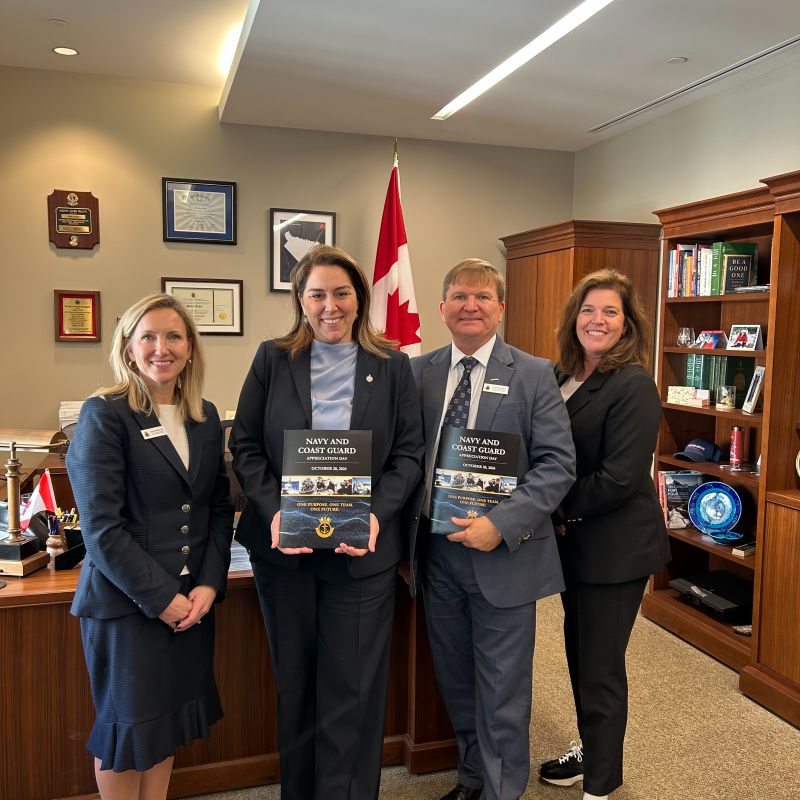
Had a wonderful opportunity yesterday to meet with Sima Acan, Member of Parliament for Oakville West, to discuss the important role the Navy League of Canada plays in supporting the strength and resilience of Canada’s marine sector. From fostering youth development and maritime awareness to helping build the next generation of leaders for our naval and marine industries, the Navy League continues to make a meaningful contribution to Canada’s maritime future. Thank you, Sima, for the engaging conversation and your keen interest in the work being done to support this vital sector.
150 Years: RMC Then and Now
What better way to celebrate 150 years of RMC than to look back at where we have been, and see how the College has evolved over the generations.
The RMC Museum’s ongoing photo digitization project is preserving historic images of the College, its people and its alumni. With generous support from the RMC Class of 60 Museum Endowment Fund, Museum staff continue the important work of digitizing this remarkable collection.
For RMC150, photographs digitized over the past two years have been brought together with current images to create Then and Now, a video slideshow celebrating the places, traditions and history that connect generations of the RMC community.
Much of the Museum’s historic collection is still waiting to be digitized. Alumni support can help continue this work, preserving RMC’s visual history and making it accessible for generations to come.
5 Questions for a General: Brigadier- General Pascal Godbout CMR RMC 1995
–https://mwi.westpoint.edu/five-questions-for-a-general-brigadier-general-pascal-godbout/
Five Questions for a General, a production of the Modern War Institute at West Point. This series features specially selected cadet hosts who are given an incredible professional development opportunity—to sit down with senior military officers and ask carefully crafted questions about everything from leadership to their unique experiences while serving to their expectations about the future of war.
In this episode, Cadet Olivia Hanson sits down with Brigadier-General Pascal Godbout, commandant of the Royal Military College of Canada, to discuss leadership, professional military education, and lessons learned from his thirty-six-year career in the Canadian Armed Forces. General Godbout reflects on his unlikely journey from a small town in Quebec to senior military leadership, explaining how a career initially motivated by educational opportunity became a lifelong commitment to service. He discusses the similarities and differences between Canadian and American military academies, emphasizing the importance of joint education, bilingualism, and developing leaders of character. Drawing on his experience at the North American Aerospace Defense Command, he highlights the importance of preparation, disciplined decision-making, and maintaining composure under pressure. He also shares lessons from commanding Joint Task Force North in the Canadian Arctic, where he learned the value of listening, respecting Indigenous communities, building trust, and understanding the human and environmental dimensions of military operations. Turning to leadership development, General Godbout stresses that technical competence must be complemented by emotional intelligence, ethical judgment, and the courage to confront misconduct. He also discusses ongoing reforms at the Royal Military College, including the need to challenge outdated traditions and strengthen accountability. Throughout the conversation, General Godbout emphasizes humility, adaptability, and lifelong learning, encouraging young officers to embrace unexpected opportunities, nurture professional relationships, and recognize that mistakes are an essential part of becoming an effective leader.
CBC’s David Common speaks with Royal Military College and Queen’s University’s Christian Leuprecht on the war in Ukraine
Queen’s launches new institute to advance nuclear materials research
The Materials at Extremes Nuclear Research Institute brings together researchers, infrastructure, and partnerships to support the future of nuclear energy in Canada.
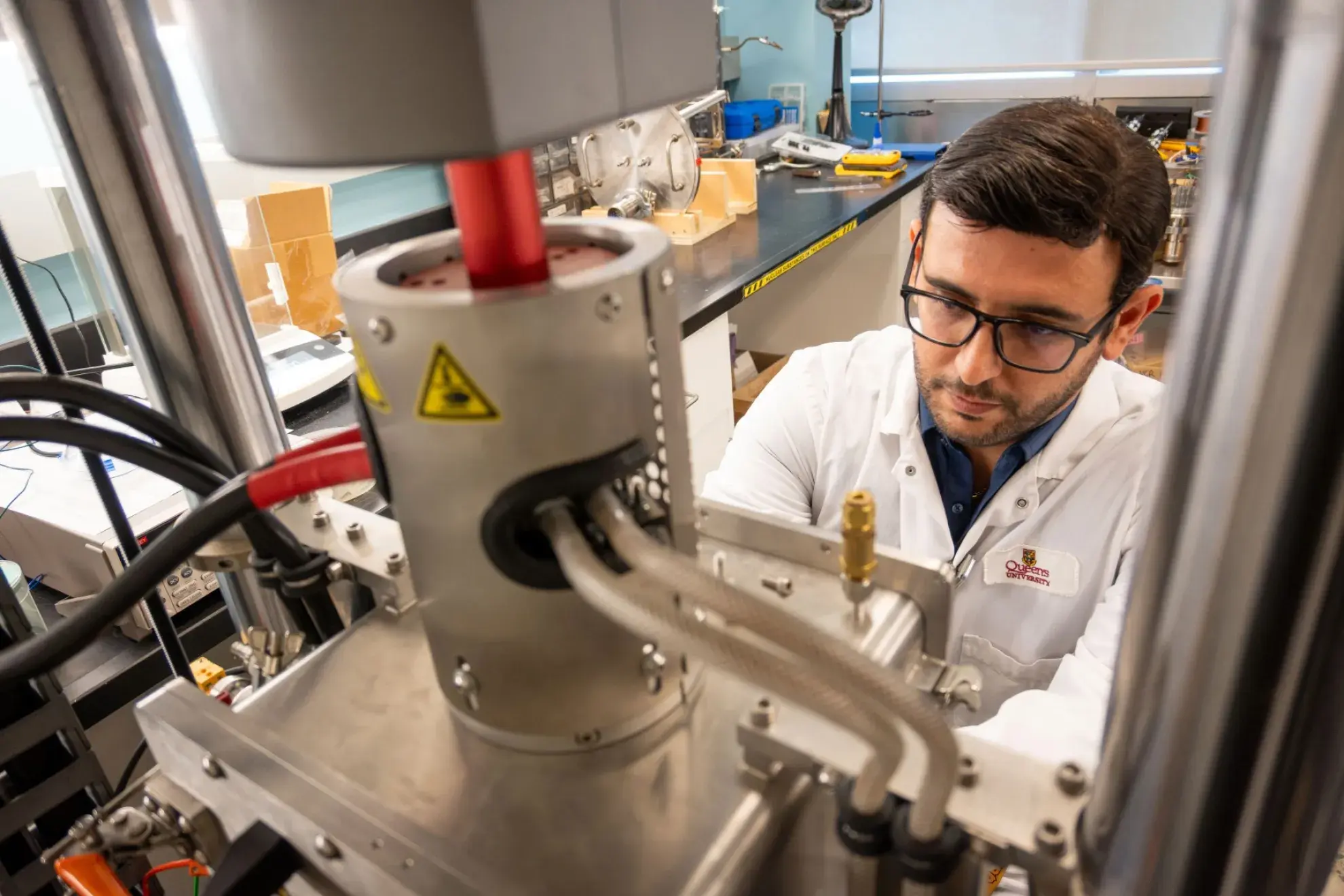
Inside a nuclear reactor, materials must withstand heat, radiation, and corrosion for years. Understanding how these conditions can change reactor components is essential to assessing how long they can remain safely in service and to developing new reactors altogether.
As Canada looks to expand nuclear energy, a new research institute at Queen’s is bringing together expertise, infrastructure, and partnerships to tackle these challenges. Recently launched, the Materials at Extremes Nuclear Research Institute (MAX-Nuclear) aims to support safe and sustainable nuclear technologies today, while advancing new ones that could move Canada toward a net-zero future.
MAX-Nuclear is one of four Tier 1 Research Institutes at Queen’s. It builds on a nuclear materials research program that began at Queen’s in 2002 and is led by Scientific Director Mark Daymond, Canada Research Chair in Nuclear Materials and Mechanics of Materials.
The institute studies how existing and emerging materials perform under the demanding conditions in current and next-generation nuclear reactors, including small modular reactors (SMRs). Its researchers bring expertise in corrosion, materials used in reactor structures, computational modelling, and the effects of radiation. This work can help guide decisions about current and future reactor design and maintenance in Canada and abroad.
Electoral integrity under pressure as elections faced persistent threats in 2025
https://www.eurekalert.org/news-releases/1147150
Elections across the world faced a wide range of pressures on electoral integrity in 2025, from violence and mis- and disinformation to electoral management malfunctions, cyber attacks and natural hazards, according to a new report.
The report, Review of the 2025 Year of Elections: Inclusivity, Transparency and Trust, from the International Institute for Democracy and Electoral Assistance (International IDEA), was written in collaboration with the Electoral Integrity Project and co-authored by Toby James, Professor of Politics & Public Policy at the University of East Anglia (UEA).
It examines 39 countries that held national elections in 2025 and looks at both the risks facing elections and how electoral institutions are responding, with a particular focus on inclusivity, transparency and trust.
“The report shows that all countries, large or small, are facing challenges in ensuring that elections truly empower people. But they also show the value of drawing lessons across borders,” said Prof James, who also co-edited the report.
“Challenges such as the role of money in elections, election disinformation and political polarisation are not confined to single countries. Efforts to improve elections should therefore be global as well.”
Electoral campaigns remain a particularly vulnerable part of the electoral cycle. The report also points to growing pressure on media integrity and campaign finance, as declining press freedom and increasingly digital financial flows create new challenges for electoral processes.
Prof Holly-Ann Garnet, from the Royal Military College of Canada, said: “New challenges to electoral integrity require innovative solutions. This report highlights some of the important steps being taken around the world to strengthen the quality of elections, as well as issues that require attention moving forward.”
Dr. Kim Richard Nossal named 34th Vimy Award Laureate
https://www.queensu.ca/politics/news/kim-nossal-vimy-award-laureate
The CDA Institute has named Dr. Kim Richard Nossal, Professor Emeritus, the 34th Vimy Award laureate.
For five decades, first at McMaster and then at Queen’s, Dr. Nossal has been the scholar to whom students, officers, diplomats, and public servants turn to understand how Canada decides. His body of work is remarkable: novel, rigorous, and wise, written in a voice so distinctive that readers can hear him on every page.
Politics of Canadian Foreign Policy, now in its fourth edition, has long been the defining textbook in the field. Charlie Foxtrot explained with rare clarity why Canada struggles to equip its Armed Forces. And Canada Alone, published just before the present strain in the Canada-US relationship, asked how this country should navigate a less reliable American order. Events have since caught up with his argument. These books form part of a prolific scholarly record that includes 12 authored or co-authored books, 13 edited volumes, 68 journal articles, and 98 book chapters.
Dr. Nossal’s scholarship alone would be worthy of the Vimy Award, yet his contribution reaches well beyond that. As Director of the Queen’s Centre for International and Defence Policy, he has championed the Kingston Conference on International Security and the Visiting Defence Fellowship, forums where soldiers, officials, and academics debate with one another rather than argue past one another. As chair of the Security and Defence Forum’s academic selection committee, he has helped sustain a national network of defence expertise.
Perhaps most importantly, his influence can be seen in the generations of students he has taught, many of whom now serve in government, in uniform, and across Canada’s universities. For those students, Dr. Nossal has been not only a teacher, but a mentor whose guidance and commitment have shaped lives and careers. He has passed on what he knows subtly and generously, as is his nature, and has given his students something rarer still: a sense of belonging in the academic community. One former doctoral student recalled his “capacity to bolster [my] scholarly confidence”. It is fitting, then, that an undergraduate teaching award now bears his name.
A Fellow of the Royal Society of Canada, an honourary graduate of the Royal Military College, and this year’s recipient of the Mildred A. Schwartz Lifetime Achievement Award, Dr. Nossal has long held the esteem of his peers. The Vimy Award now adds the gratitude of the defence community he has served faithfully. It is with great pride that we celebrate him as the 34th Vimy Award laureate.
The Vimy Award honours “Canadians who have strengthened our nation’s defence, security, and democratic values.”
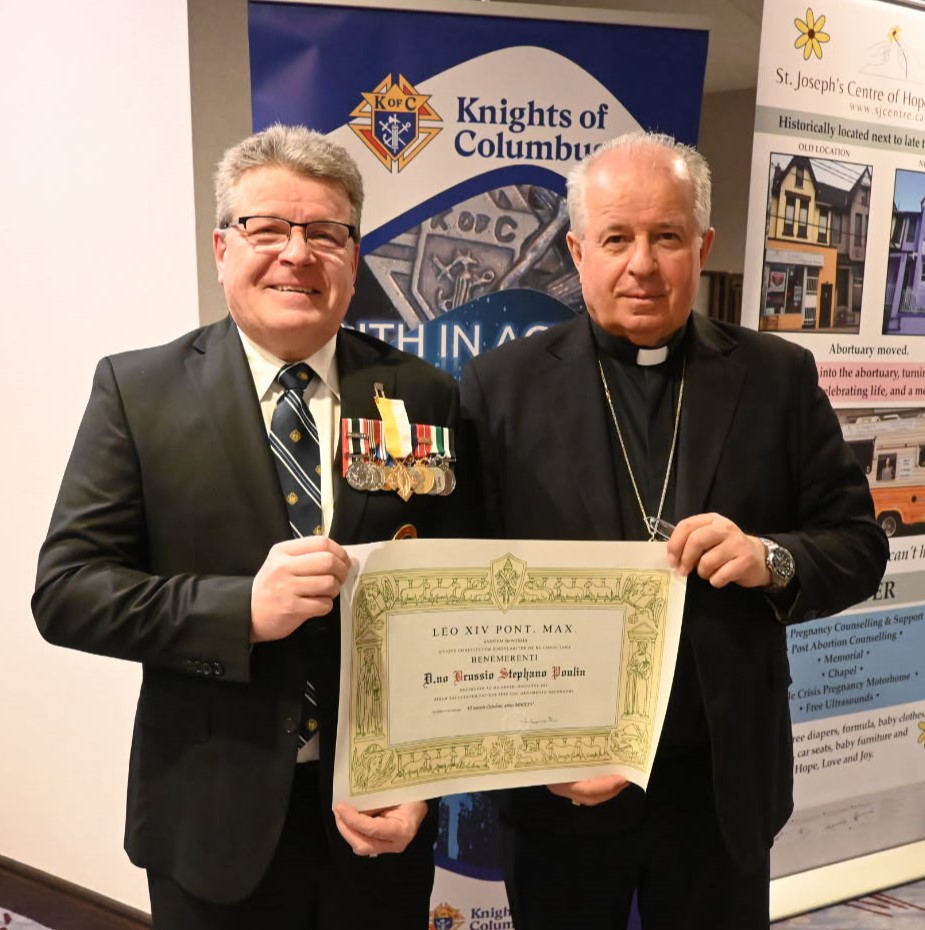
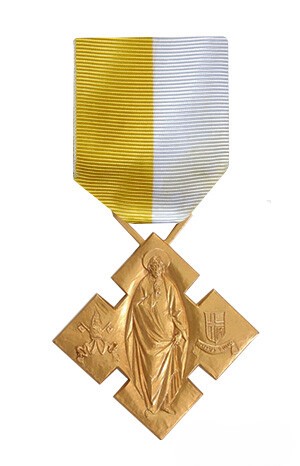
Papal Benemerenti Medal and Order of Malta – Capt B.S. Poulin (Ret’d)
Sovereign Military Order of Malta:
Prince and Grand Master Fra’ John T. Dunlap has officially approved the admission of the senior representative of the Canadian Wheelchair Foundation, Captain Bruce S. Poulin, CD, OMC (Ret’d) to the Sovereign Military Order of Malta on September 26, 2026, at the Notre-Dame Cathedral Basilica in Ottawa, ON.
-
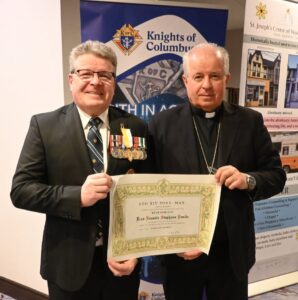
- Presentation Benemerenti Medal
-
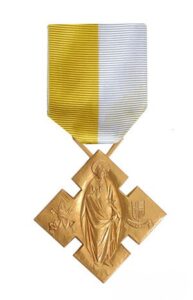
- Vatican Benemerenti Medal
-
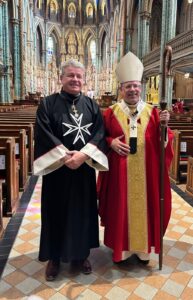
- Investiture Ceremony
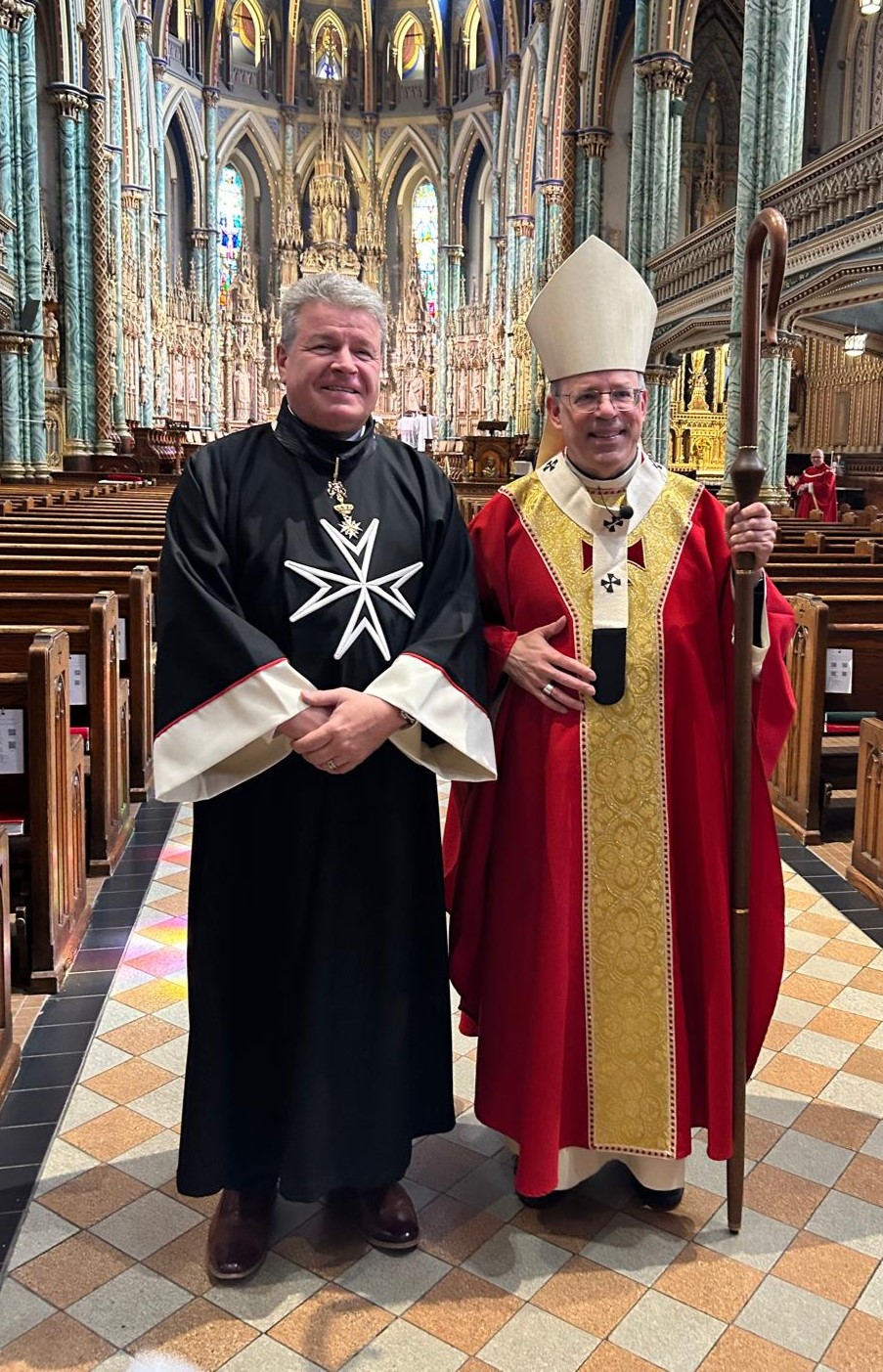
The Sovereign Military Order of Malta (after 1798), officially the Sovereign Military Hospitaller Order of Saint John of Jerusalem, of Rhodes and Malta (a.k.a. the Knights Hospitaller), is a Catholic military order. It may be traced back to the establishment of a hospital in Jerusalem dedicated to St. John the Baptist. Constructed sometime between 1070 and 1080 near the Church of the Holy Sepulchre, in Jerusalem, this facility aimed to care for sick and poor Christian pilgrims who travelled to the Holy Land during a time of growing religious traffic and increased risk.