New Books on the RMC Department of Electrical and Computer Engineering
From Oil lamps to Cyberspace – Electrical and Computer Engineering at RMC 1876-2025
RMC opened in 1876 as the fourth Canadian engineering school. Electrical engineering topics were part of the curriculum from the beginning. However, for the first 26 years after the college opened, students studying electricity after dark had to do so by the light from oil lamps.
An autonomous Department of Electrical Engineering was only established after the College reopened in 1948. Since that time, members of the department have carried out research at the leading edge of electrical and computing technology, contributing to its rapid evolution and integrating their knowledge within the College and in support of the Canadian Armed Forces, the Department of National Defence and the broader technology community.
This book describes the electrical and computer work at RMC over the course of the 150 years since the founding of the College. Each chapter covers a particular era and first provides brief background information about the political, military, social and technological context in that era. The activities and evolution of teaching and research at RMC are then presented within that context, with particular emphasis on electrical and computer engineering.
The books include the names and photographs of students in every graduating undergraduate class since the reopening in 1948, all academic faculty members since then, and for all administrative and technical staff who could be identified. Names of post-graduate students are listed in an annex.
These books are part of a larger project to document the history of the academic part of RMC. It follows those on Mechanical and Aerospace Engineering (2018), and Chemistry and Chemical Engineering (2025).
The co-authors are both members of the RMC class of 1969, and that class also provided most of the funding for the clerical and research work needed to produce this book.
English and French versions of the book are available in the RMC Alumni Association shop at a current cost of $30.

Nouveau livre sur le Département de génie électrique et génie informatique au Collège militaire royal du Canada 1876-2020
De la lampe à l’huile au cyberespace – Génie électrique et génie informatique au Collège militaire royal du Canada 1876-2020
Le CMRC a ouvert ses portes en 1876 à titre de quatrième école d’ingénierie au Canada. Les sujets liés au génie électrique faisaient partie du programme d’études dès le début. Cependant, durant les 26 premières années suivant l’ouverture du collège, les élèves-officiers qui étudiaient l’électricité après le coucher du soleil devaient le faire à la lueur de lampes à huile.
Un département de génie électrique autonome n’a été créé qu’après la réouverture du collège en 1948. Depuis, les membres du département mènent des recherches à la fine pointe des technologies électriques et informatiques, contribuant à leur évolution rapide et intégrant leurs connaissances au sein du Collège ainsi qu’au soutien des Forces armées canadiennes, du ministère de la Défense nationale et de l’ensemble de la communauté technologique.
Ce livre décrit les travaux en génie électrique et informatique réalisés au CMRC au cours des 150 années écoulées depuis la fondation du Collège. Chaque chapitre porte sur une époque particulière et présente d’abord de brefs renseignements contextuels sur la situation politique, militaire, sociale et technologique de cette période. Les activités et l’évolution de l’enseignement et de la recherche au collège sont ensuite présentées dans ce contexte, avec un accent particulier sur le génie électrique et informatique.
Les livres comprennent les noms et les photographies des élèves-officiers de chaque promotion du premier cycle depuis la réouverture en 1948, de tous les membres du corps professoral, ainsi que de tous les membres du personnel administratif et technique qui ont pu être identifiés. Les noms des étudiantes et étudiants des cycles supérieurs figurent dans une annexe.
Ces ouvrages font partie d’un projet plus vaste visant à documenter l’histoire de l’aile académique du collège. Celui-ci fait suite aux ouvrages sur le génie mécanique et aérospatial (2018), ainsi que sur la chimie et le génie chimique (2025).
Les deux coauteurs sont membres de la promotion de 1969, laquelle a également fourni la majeure partie du financement nécessaire aux travaux administratifs et de recherche requis pour produire ce livre.
Les versions française et anglaise du livre sont offertes à la boutique de l’Association des ancien(ne)s des collèges militaires canadiens au prix actuel de 30 $.
Book Review : Into the Breach
- By General (ret) Wayne Eyre
- Published by Simon and Schuster 413 pp. $45.00
- Review by 12570 Mike Kennedy
Reflections on a Lifetime of Adventure, Service, and Achievement
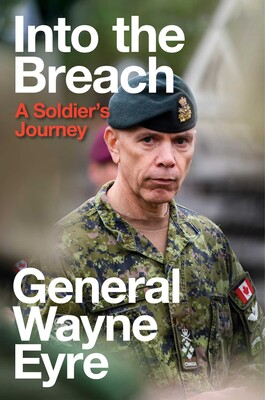 Within the pages of the 1986 RRMC yearbook there is to be found a profile of 16538 Wayne Eyre, then completing his second year at the College. After describing some of Eyre’s hijinks as a first-year cadet, the profile goes on to allude to “….the love that Ms. Right could give him while fighting in Afghanistan.” Little could the author of those words first written 40 years ago have imagined just how prophetic they would eventually turn out to be. In his new book, Into the Breach, Eyre retraces the steps of a remarkable odyssey that was destined to take him from prepubescent Army Cadet to the highest military office in the land.
Born on a Saskatchewan farm at the time Canada was celebrating its Centennial, from an early age Wayne Eyre was an enterprising and adventurous lad who aspired to no vocation other than military service. In September 1979, as soon as he was old enough, he signed up for the local Cadet Corps, an important formative experience he credits with providing skills and newfound confidence that would serve him well in his future career. Following high school graduation in 1984 he arrived at Royal Roads, where he would spend his first two years in the military college system as a member of Fraser Flight. After that it was off to Kingston, where he would complete his degree at RMC and meet the woman who later became his wife. In 1988, with commission in hand, he proceeded to Gagetown to complete infantry phase training, and from there it was on to a posting with the PPCLI as a newly minted subaltern.
Over the next 30 years Eyre would go on to have a remarkable career that would encompass first-had involvement in many of the events that would shape the ongoing evolution of the Canadian Forces. As a young Captain in 1993 he was present at the Battle of Medak Pocket; years later as a Lieutenant Colonel he would deploy to Afghanistan at the height of the war, where he earned a Meritorious Service Cross for his leadership. Appointed as a General Officer in 2012, his career over the next several years included a return deployment to Afghanistan, command of the 3rd Canadian Division, senior assignments in Military Personnel Command and the United Nations Command in Korea, and ultimately, appointment in 2019 as Commander of the Canadian Army.
But undoubtedly the greatest test of Eyre’s leadership was to come in the early winter of 2021, as a time when Canada was in the throes of struggling with the unprecedented COVID 19 pandemic. Late one February night, he received an urgent phone call from the Minister of National Defence directing him to report immediately for a meeting. Making his way to downtown Ottawa through a snowstorm, when Eyre arrived he was asked by the Minister to step into the CDS role on an interim basis in the wake of a decision by the incumbent to step aside amid allegations of misconduct. Eyre was initially hesitant about accepting the role, but his sense of duty quickly prevailed, and he agreed to step up to the plate. In August of 2021 he was promoted to the rank of General, and in November of that year confirmed as CDS on a permanent basis, a position in which he continued to serve until his retirement in 2024.
Much of Into the Breach is devoted to an in-depth discussion of the many challenges Eyre had to deal with during his tenure as CDS. Throughout the book, a number of themes repeatedly emerge. One of the most important of these highlights the remarkable dedication and ingenuity of Canada’s men and women in uniform. In stark contrast to their colleagues in other first world militaries, members of the CAF have often been compelled to carry out their duties relying upon equipment that is outdated, ill suited for the task at hand, and all too often insufficient in quantity. Despite these limitations, time and again they have never failed to rise to the occasion and get the job done. Notwithstanding the many shortcomings of their gear, the skill and professionalism of our military members is second to none.
Eyre’s book also provides some fascinating insights into the complexities of the issues senior leaders must deal with as they attempt to navigate the rocks and shoals of the political environment in which the CAF must operate. He candidly acknowledges that over the years he has had his share of differences with certain elected officials. At the same time, however, he has always taken great care to respect the authority of the civilian leadership to whom the CDS reports and conduct himself in a manner befitting the gravity of the office.
Possibly the most important messages offered by this book may be found in the final chapter, in which Eyre offers his own personal perspectives on the key issues Canada is facing as we look to the future. Figuring prominently among these is his conviction that the days when our country could afford to be complacent about the protection of our sovereignty and security are now long gone. In a complex and increasingly dangerous world, Canada needs to start pulling its weight and make the necessary investments to build and sustain the kind of modern, well equipped military force that will be capable to responding to future threats that may emerge.
Reading his story, it seems clear that for Wayne Eyre military service was certainly not just a job and probably not even a career. Rather, it was a calling whose nobility inspired him from a very early age, and one that has shaped his life journey ever since that time. Arguably, Eyre himself could be considered to be the epitome of a modern-day professional officer. He’s a battle-hardened warrior who’s completed some of the toughest military training around, and who has repeatedly proven his mettle on operations in some of the world’s more dangerous and volatile hotspots. At the same time, his book reveals that he is also clearly a thinking man’s soldier who is blessed with a formidable intellect and a rare ability to articulate his views in a highly coherent and compelling manner.
Into the Breach is a book that offers a wealth of leadership insights that will be valuable to military professionals of all ranks and occupations. But is also a book that conveys some powerful and vitally important messages that Canadians of all walks of life need to hear. Our country should be immensely grateful to Wayne Eyre not only for his lifetime of exemplary military service, but also for the words of wisdom that he shares in this book.