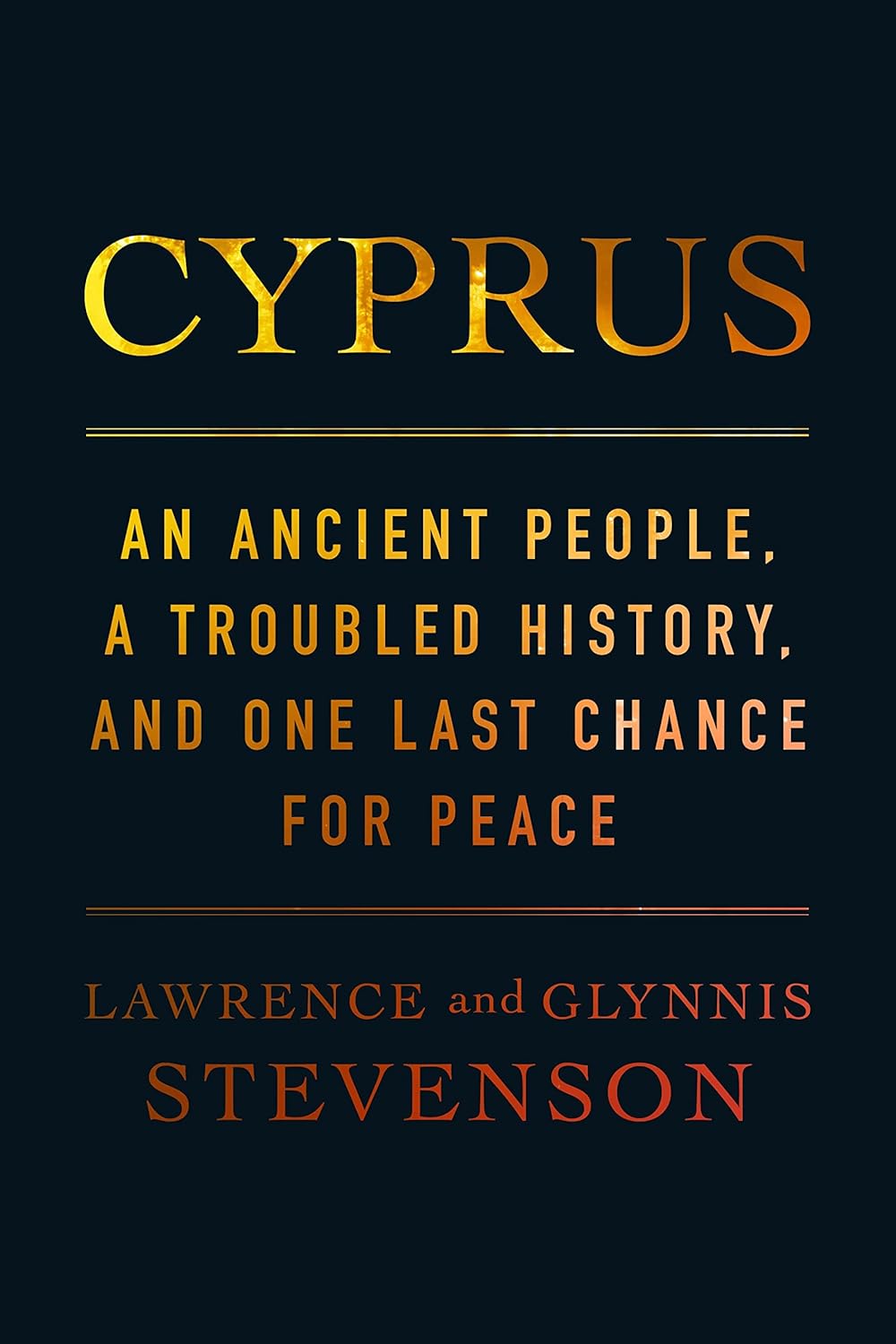
Cyprus: An Ancient People, A Troubled History, and One Last Chance at Peace
By Lawrence and Glynnis Stevenson
- Publisher : Sutherland House
- Publication date : April 15 2022
- Language : English
- Print length : 280 pages
- ISBN-10 : 1989555632
- ISBN-13 : 978-1989555637
- Price $34.95 via Amazon – https://www.amazon.ca/Cyprus-Ancient-People-Troubled-History/dp/1989555632
Review by 12570 Mike Kennedy
The summer of 1974 was an eventful time, both in North America and around the world. In the United States the embattled Richard Nixon became the first President in American history to resign in disgrace. Meanwhile in Canada, the government of Prime Minister Pierre Trudeau, which had struggled with a tenuous minority since the fall of 1972, was given a new lease on life. On July 8th, Trudeau’s Liberals were re-elected with a majority, winning 141 of the 264 seats in Parliament.
At the same time these events were unfolding, halfway across the world the tiny island republic of Cyprus was rocked by violence. On July 15th, acting on the orders of the military junta that ruled Greece at the time, the Cypriot National Guard staged a coup d’etat which deposed the republic’s President and replaced him with their puppet Nikos Sampson, whose marching orders were to unify Cyprus with Greece. Just days later, and fearing for the safety of the island’s minority Turkish population, the government in Ankara decided to intervene. Early on the morning of July 20, the Turks launched Operation Attila, landing 3,000 troops on the eastern coast of Cyprus. This initial invasion was followed a few weeks later with a much larger operation, when the Turks dispatched a force of 40,000 soldiers and 180 tanks to the island.
By the time the fighting finally died out on August 18th, the two opposing sides had suffered combined losses of over 10,000 casualties.
The 1974 invasion might have seemed like an isolated incident, but in reality it could probably be more accurately characterized as being a short-lived but spectacular act in an ongoing tragedy that has been unfolding for centuries. A new co-authored book by 11721 Larry Stevenson and his daughter Glynnis offers an in-depth analysis of the many factors that have contributed to ongoing tension between the island’s two ethnic groups. The Stevensons explore the numerous attempts at reconciliation that have been made over the years, all of which have ended in failure, and offer some fresh perspectives on what could potentially be done to bring lasting peace to this beautiful but troubled enclave.
Larry Stevenson himself was first exposed to Cyprus in 1980 when as a young PPCLI officer his battalion was posted to Cyprus for a peacekeeping tour, the first of two he would eventually serve on the island. By that time, Canadians had already served on the island for more than fifteen years, and 20 had already given their lives in the line of duty. As the book notes, ever since the first Canadian soldiers arrived in Cyprus in 1964, more than 35,000 Canadian military personnel have done peacekeeping duty there, and of those, 28 never made it home.
Nearly six decades have now passed since the United Nations first attempted to bring peace to the island, but even today some 1,000 military and civilian personnel drawn from 25 different nations, including Canada, remain stationed on the island. The annual cost of this mission is estimated to be over U.S. $50 million. Yet despite the massive expenditures of manpower and money that have been dedicated to helping prevent the island’s two competing factions from anahilating each other, the Cyprus question remains no closer to a final resolution than it ever was at any time in the past.
Cyprus’s troubles are rooted in the competing interests of the island’s two major population groups, the Greek Cypriots in the south and their Turkish Cypriot neighbors to the north.
The Greek Cypriots, who make up the majority of inhabitants, sought to achieve “enosis”, a final union with Greece. The Turkish Cypriot population, meanwhile, had the goal of “taksim”, meaning a partition of the island.
During the post-colonial era the governments of Britain, Greece, and Turkey – working together without input from the Cypriots – sought to achieve a compromise that would allow Britain to maintain a presence on the island while at the same time granting Cyprus its independence. A deal was eventually reached, but no one was happy with the outcome. The first hints of the difficulties that were soon to beset Cyprus came in 1963, when the Greek Orthodox Archbishop Makarios III, the first President of the republic, launched the “Akritas Plan”, which was intended to pressure the Turkish-Cypriot minority into accepting constitutional changes by, among other things, forcibly relocating 30,000 of them from their homes. The island was soon engulfed in violence that claimed over 500 lives, the majority of who were Turkish-Cypriots.
Watching these events from only 40 miles away, the Turkish Government threatened military intervention to protect the Turkish-Cypriot population. They were dissuaded from following through by a sternly worded message from U.S. President Lyndon Johnson, and in early 1964, the United Nations Security Council passed Resolution 186 in March, which created the United Nations Peacekeeping Force in Cyprus (UNFICYP). Apart from a short-lived crisis in late 1967, for most of the next ten years the UNFICYP managed to keep the situation on Cyprus under relative control.
Things began to change dramatically in 1974 when on July 15 Archbishop Makarios was ousted in a coup d’etat orchestrated by the military junta that had ruled Greece since 1967. Installed in his place was Nicos Sampson, a violent demagogue who made no secret of his hatred for Turkish-Cypriots. The Turks, believing they had no choice but to intervene to protect their Turkish-Cypriot cousins, launched Operation Attila on July 20. Thankfully, the war proved to be short lived, and by August 18 it was effectively over.
Nearly fifty years have passed since the ceasefire of August 1974, but nonetheless the island’s two ethnic factions remain as deeply divided as ever before. Over the years numerous attempts to attain a lasting reconciliation have been made; all have ultimately ended in failure. Probably the closest Cyprus has ever come to resolving its ongoing dilemma was in the early 2000’s. when UN Secretary General Kofi Annan advocated for a deal which became known as the “Annan Plan”. Under the plan, Cyprus would have a federal parliament composed of an upper and lower house, and a presidential executive council composed of six members including representation from both the Greek and Turkish Cypriot communities.
The Stevensons note that the Annan Plan had its imperfections, but they nonetheless assess it as having the potential to be workable. Sadly, when the plan was put to a vote by the island’s inhabitants in the spring of 2004, it was overwhelmingly rejected by the Greek-Cypriot population, who had been heavily influenced by the vigorous lobbying of their President, Tassos Papadopoulos.
The book notes that a number of obstacles continue to prevent the two competing groups of Cypriots from reaching some form of mutually-acceptable consensus. Probably the biggest barrier can be traced to the profound cultural divides that exist between the island’s two ethnic populations. Greek-Cypriots and Turkish-Cypriots live in separate communities. Interaction between the two groups is limited, and intermarriage is almost unheard of. From an early age, children of the two communities are educated in separate school systems that teach dramatically different versions of the island’s history, and that have often sought to portray members of the rival community in a highly unfavourable light.
The Stevensons argue that in an ideal world the solution would be to achieve a “Bi-Zonal, Bi-Communal” (BZBC) model of governance, wherein the two communities would have their own separate states with clearly defined rights and responsibilities, and the island as a whole would have a central government with jurisdiction over certain aspects of national affairs, such as security and foreign relations. Appealing as the BZBC model might seem in theory, the Stevensons conclude that it is highly unlikely to ever work in Cyprus, mainly due to the deep-seated unwillingness of the two groups to agree on a suitable compromise.
Instead, the solution that the two authors advocate is that of a “velvet divorce” wherein the two communities respectfully decide to go their separate ways, and agree on a set of terms that will enable them to co-exist peacefully. Achieving a velvet divorce will not be easy; a survey conducted as recently as 2020 showed that support for the idea remains low, especially among the Greek-Cypriot majority. But the Stevensons remain hopeful. The note that members of both groups, and especially younger Cypriots, want to move on from the difficulties of the past.
Since the spring of 1964 hundreds of thousands of soldiers have served under the banner of the UBFICYP, and Canadians have figured very prominently among them. The presence of the peacekeepers has never managed to enable the island’s inhabitants to live in an environment free of the ever-present threat of violence. The solution proposed by the Stevensons may be the one that finally offers “one last chance at peace”.
The Stevensons’ book offers an examination of the situation in Cyprus that is detailed, thoughtful, and extremely well-researched, and the two authors present some compelling arguments to support the viability of the solution they propose. This is a book that should be read by anyone with an interest in Cyprus and its history, and in particular, by all Canadian veterans who at some point in their careers have planted their boots on that remote and beautiful piece of Mediterranean soil.