
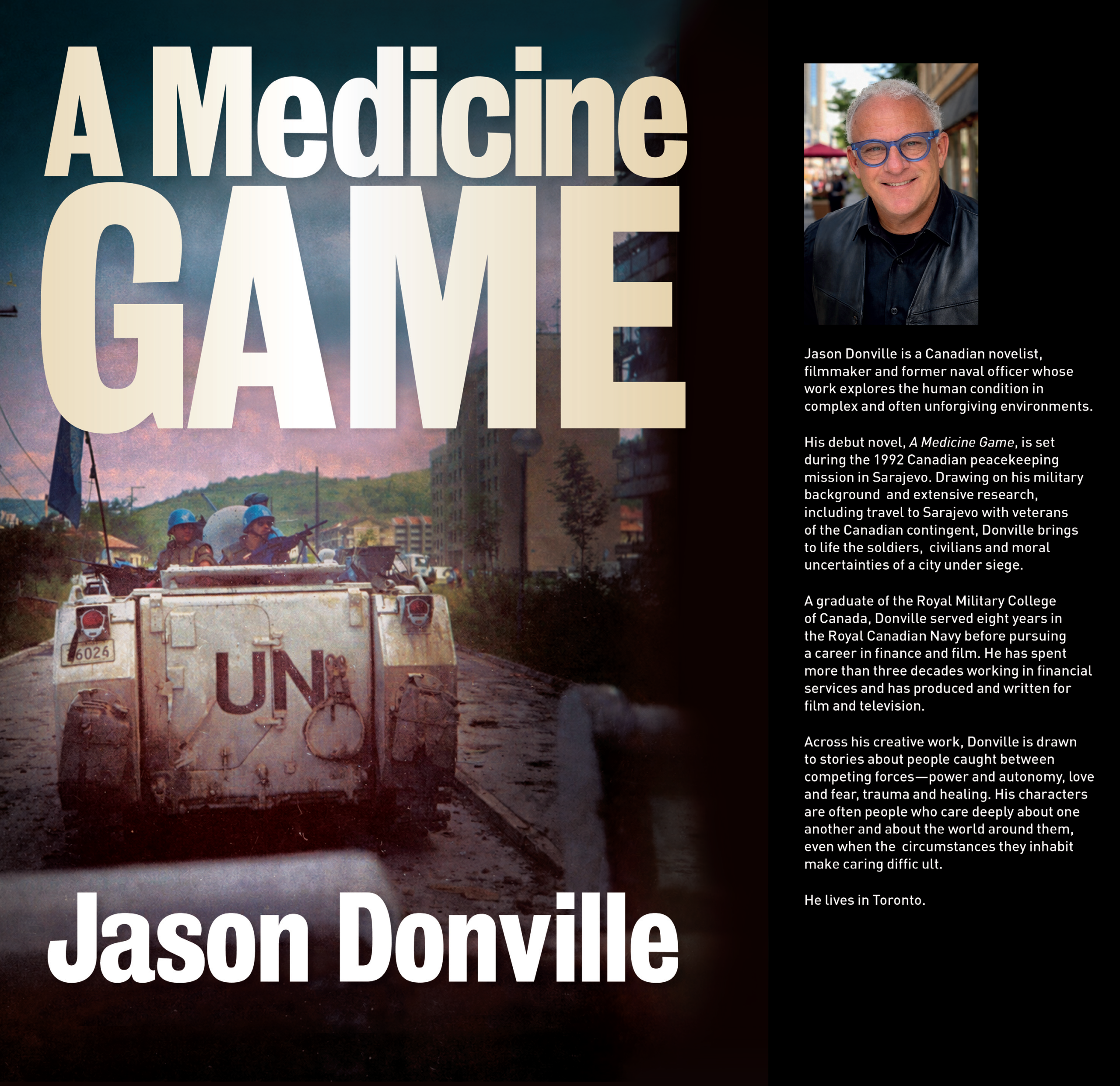
A Medicine Game
- Author: Jason Donville
- Reviewed by: Daryl Tremain
- North Vanguard Press, 2026, 280 pages,
- ISBN 9781069872173
- $23.99
- https://northvanguardpress.com/book/a-medicine-game/
A Moving Account of a Young Officer at Mil Col, Sarajevo and Beyond
Jason, a classmate of mine at RMC (Class of ’86), begins his novel with a vivid account of his time at Royal Rhodes, from 1982 to 1984. In these engrossing chapters, we learn about life at that famed and, unfortunately, closed institution. We also meet the protagonist’s indigenous friend, rival, and mentor of sorts, who features prominently throughout the work.
Jason’s lively prose takes us through his military training both during his time at Mil Col and afterwards. He freely shares his emotions, both high and low: his ambition, excitement, jealousy, self-doubt. The reader meets his family and becomes familiar with the disappointments and challenges Jason faced as a child and as an adult in a distant, detached family.
The military context reaches its most intense point during the siege of Sarajevo amid the civil war accompanying the break-up of Yugoslavia. This portion of the book affected me the most, as I had never read such a detailed and horrific account of those unfathomably tragic events. I commend the author for bringing us into the intimacy of that experience without it feeling voyeuristic or gratuitously violent.
Throughout the novel, and especially in Croatia and Bosnia, Jason deftly portrays the ethical conflicts that he, his men and his comrades faced. Whether in training or in combat, the reader is immersed in the dilemmas and choices confronting the protagonist, leaving us with material for contemplation, and a heightened appreciation for the trauma suffered by those who fought and survived.
The latter part of the book brings us face-to-face with the resulting trials and multi-year recovery from the psychological and physical scars we witness. The isolation, powerlessness, and devastation caused by PTSD resonate in those chapters. The denouement brings us closer to indigenous culture, and encourages empathy and compassion for those whose stories we don’t know.
Having struggled with PTSD myself, I felt very close to the Jason of the novel, as well as his close friend, as they avoided and then faced the challenges of trauma and recovery. While I sense this is a novel rather than strictly a memoir—auto-fiction I think it might be called—it is clear that Jason has experienced much of what he recounts, which gives the narrative intensity and believability. I was drawn into the narrative quickly, cared about the main characters, and yearned to know their fate. I didn’t want to put the book down.
As a member of Jason’s class, but one who attended only RMC, I was captivated by his evocation of life at Rhodes, surrounded by rainforest. I am grateful to finally understand what made RRMC so different from our experience in Kingston and why it was so hard for the Rhodents to adjust after their arrival in third year. Uncharitably: what all the whining was about; more compassionately: what a difficult transition it was from tight-knit unit to a larger, more diffuse and bureaucratic college.
While much of the writing is gripping, I have a few quibbles with some of the images that Jason uses. Some seem forced, some misplaced, and others I fail to understand. However, many images work well, and deepened my experience of reading.
I encourage ex-cadets to read this book. I can also imagine those with no military background engaging with it. Ex-cadets who attended Royal Rhodes will enjoy the nostalgia, those who want to understand the challenges of the Rangers course or the siege of Sarajevo more deeply will be more than satisfied. As for those who have struggled with PTSD or witnessed it in others, this account will ring true and may offer comfort.
I was also very moved by the weaving of indigenous culture, wisdom, and healing into Jason’s story. It is an integral part of the book and merits the highlighting it receives in the title. May we integrate it increasingly in our perspectives on life and our journeys of healing.

