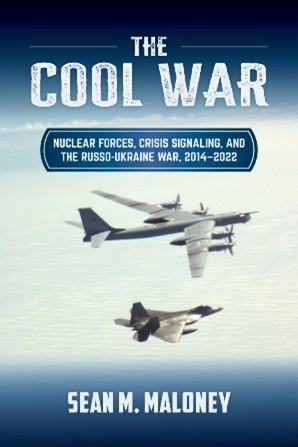
Title: The Cool War: Nuclear Forces, Crisis Signaling, and the Russo-Ukraine War, 2014 – 2022
Author: Dr. Sean Maloney
Edition: First Edition
Print length: 408 pages
Publisher: Naval Institute Press
Publication date: Oct. 24 2025
ISBN-13978-1682476895
Price: $69.50 – Hardcover edition
Overview
Nuclear signaling is defined as the deliberate maneuvering of nuclear forces to deter and influence an adversary’s actions. Author Sean Maloney shows how Russian leader Vladimir Putin has systematically employed nuclear signaling to force desired behavior from both NATO and the United States. This strategy has escalated greatly during the Russo-Ukraine War as Putin seeks to deter Western intervention and support of Ukraine.
Putin uses many forms of nuclear signaling, including ordering jets capable of carrying nuclear weapons to fly in western European airspace, staging a joint bomber exercise with China near Alaska, and instructing submarines carrying nuclear weapons to surface through the Arctic icepack. The frequency of this signaling far exceeds that of similar activity during the Cold War and has escalated to more dangerous levels than before. When Russia experienced setbacks on the battlefield, Putin often intensified his nuclear-force posturing by paring it with thinly veiled threats to use tactical nuclear weapons.
Maloney argues convincingly that in the post–Cold War era, Putin has skillfully combined his use of nuclear signaling with advances in information technology to more effectively manipulate Western nations. He asserts that the United States was initially late in recognizing this development, but as the situation worsened, America and NATO have devised a series of responses that now hold Russia in check. The question is, for how long?
Maloney concludes that Putin’s nuclear posturing has produced mixed results. First and foremost, Putin did successfully deter the United States and other NATO countries from outright military action in defense of Ukraine following the 2022 invasion. However, Russia’s nuclear signaling did not prevent the West from providing weapons and intelligence to Ukraine, nor did it stop NATO’s expansion. Nevertheless, the partial success of Russia’s Cool War activity does not lessen the significance of this new reality or the scope of the problems that face the West moving forward.
About the Author
Sean Maloney is a professor of history at the Royal Military College of Canada and served as the historical advisor to the Chief of the Land Staff during the war in Afghanistan. He previously served as the historian for 4 Canadian Mechanized Brigade, the Canadian Army’s primary Cold War NATO commitment after the reunification of Germany and at the start of the Balkan conflicts. From 2001 Dr. Maloney focused nearly exclusively on the war against the Al Qaeda movement and its allies. After returning to Royal Military College, Dr. Maloney refocused on the Cold War. His latest book, Emergency War Plan, received the Air Force Historical Foundation’s Air Power Book Prize in 2024.
Editorial Reviews
“In this very timely work, Sean Maloney argues persuasively that Putin’s reign of power in Russia has been characterized by a new way of nuclear deterrence signaling that it is woven together with advancements in information technology. This period, which the author terms the “Cool War,” extends to the present day. To back up his argument, Sean takes the reader through a history of nuclear and conventional signaling up to the eve of the current Ukraine crisis. Readers interested in deterrence, nuclear operations, U.S.-Russian relations, and the Russo-Ukrainian War would all benefit from reading this book.”—Melvin Deaile, Director of the School of Advanced Nuclear Deterrence Studies, USAF Air Command and Staff College
“This is an essential reference to understand how Russia’s president Putin has employed strategic nuclear forces in his 21st century crusade to subjugate Ukraine and intimidate Europe and America. Strategic signalling using nuclear forces, coupled with modern information warfare, is an integral part of the confrontation between democracies and authoritarian regimes. It is crucial that we understand this to develop effective national security strategies for the decades ahead.”—Maj. Gen. Mick Ryan, AUA (Ret.), author of The War for Ukraine and War Transformed