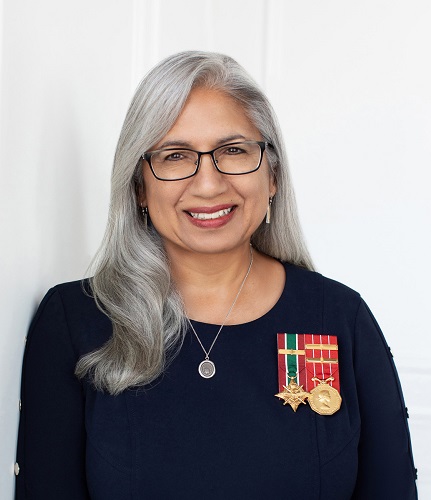
Colonel (Ret’d) Nishika Jardine, RMC 1986, has spent most of her adult life in service to Canada. First as an officer in the Canadian Armed Forces, and now as Veterans Ombud, her career has been shaped by a steady commitment to people, fairness, and the responsibility that comes with leadership.
She enrolled in the Canadian Armed Forces in 1982 in Sault Ste. Marie, Ontario, and graduated from the Royal Military College of Canada in 1986 with a Bachelor of Science in Mathematics and Physics. Like many RMC graduates, she left the College with both an education and a sense of purpose. What followed was a military career of almost 37 years in the Corps of Royal Canadian Electrical and Mechanical Engineers (RCEME), a career that took her across Canada and placed her in leadership roles supporting the Army, Navy, and Air Force.
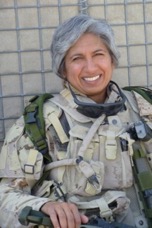 Her work brought her to Canadian Forces Base Gagetown, CFB Esquimalt, and 19 Wing Comox, where she served and led in maintenance organizations that are essential to keeping military operations moving. These are the kinds of roles that may not always be highly visible to the public, but they are critical to the effectiveness of the Canadian Armed Forces. Equipment must be ready. Systems must work. Teams must be trained, supported, and led well. Nishika built her career in that practical, demanding space where leadership is measured not by words, but by whether people and operations are properly supported.
Over the years, she held a wide range of staff and command appointments. She served as RCEME Officers Career Manager, Staff Officer to the Vice Chief of the Defence Staff, Program Officer for the National Security Studies Program, and Deputy Project Manager for the Medium Support Vehicle System. She was also the senior staff officer responsible for the strategic sustainment of the Joint Task Force for Operation ATHENA in Afghanistan. Each of these roles called for sound judgment, attention to detail, and an ability to work across large and complex organizations.
From 2008 to 2010, she commanded the RCEME School, helping shape the next generation of technical and maintenance leaders in the Canadian Armed Forces. In 2014, she was promoted to Colonel and went on to serve as Director Armament Sustainment Program Management before her final posting as Deputy Commandant at the Canadian Forces College. She completed her military service in May 2019.
Her learning also continued throughout her career. In addition to her RMC undergraduate degree, she completed both Army and Canadian Forces Staff College programs, earned a Master’s Degree in Defence Studies from RMC, and later received the Chartered Director designation. That mix of military experience, education, and governance training has carried naturally into her work after uniformed service.
After leaving the Canadian Armed Forces, Nishika continued to contribute in ways that kept service at the centre of her work. She served on the Board of Directors of Stevenson Memorial Hospital in Alliston, the Board of Governors of the Air Cadet League Ontario Provincial Committee, the Board of Directors of the Order of St. George, and the Board of Directors for the RCEME Museum and Heritage Foundation. These roles reflect a continued interest in community, youth, heritage, and the people who support Canada’s military family.
In November 2020, she was appointed Veterans Ombud, taking on a national role focused on fairness for Veterans and their families. The work of the Office of the Veterans Ombud is direct and important. It reviews complaints related to the Veterans Bill of Rights, looks at issues connected to programs and services administered by Veterans Affairs Canada, and identifies systemic problems that affect Veterans and their families.
For Nishika, this role is another form of service. It is about listening carefully, asking difficult questions when needed, and helping ensure that the systems meant to support Veterans are working as they should. It is also about dignity. Veterans and their families deserve to be treated with respect, to understand the decisions that affect them, and to have somewhere to turn when they believe something has gone wrong.
Her career stands out not because it follows a single straight line, but because it shows the many ways service can continue over a lifetime. She has led in technical organizations, worked in operational support, helped develop future leaders, contributed to governance and community organizations, and now advocates for those who have served Canada.
For the CMC community, Nishika’s path is a strong example of what a career in service can look like beyond graduation. It is practical, steady, and deeply human. It is about taking responsibility, supporting others, and continuing to serve long after the uniform has been put away.