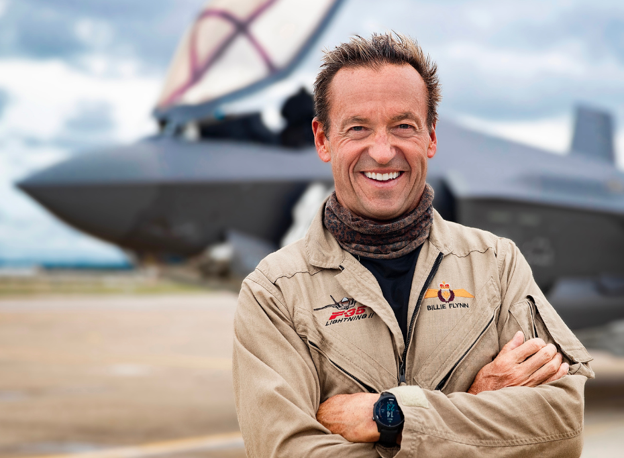
Few careers capture the full breadth of military aviation, advanced flight testing, and global defence leadership quite like that of Billie Flynn, CMR RMC 1981. From operational missions over Kosovo to the development of one of the world’s most sophisticated fighter aircraft, Flynn has spent more than four decades at the leading edge of aerospace innovation. His story is one of precision, courage, and an enduring commitment to service, qualities shaped early in his career and carried forward across every cockpit, command, and strategic role that followed.
A graduate of the Royal Military College of Canada, Flynn went on to serve 23 years in the Canadian Armed Forces, retiring as a Lieutenant-Colonel and Combat Squadron Commander. During that time, he built a reputation as a highly capable fighter pilot and leader, entrusted with demanding operational responsibilities at home and abroad. He led 441 Tactical Fighter Squadron and commanded Canadian Task Force Aviano during Operation Allied Force, flying combat missions over Kosovo and the former Republic of Yugoslavia. The unit’s contributions were later recognized with Battle Honours awarded by Queen Elizabeth II, marking an important chapter in Canadian military aviation history.
Flynn’s path was distinguished from the outset. In 1984, he became the first pilot selected to fly the CF-18 Hornet, a milestone that reflected both his skill and the confidence placed in him at a pivotal moment in Canada’s fighter program. That early achievement opened the door to an increasingly specialized career in advanced flight testing, where technical expertise, judgment, and composure under pressure are essential. His work brought him into collaboration with the United States Air Force, NASA, and allied partners, broadening his impact well beyond Canada’s borders.
After retiring from military service, Flynn did not step away from the future of aviation, he moved even closer to it. As Senior F-35 Experimental Test Pilot for Lockheed Martin, he played a critical role in the development of the fifth-generation fighter aircraft, one of the most advanced and complex defence programs in history. The role demanded not only exceptional flying ability, but also the capacity to assess emerging technologies, communicate risk, and help shape aircraft performance in real-world conditions. Flynn also served as the program’s global spokesperson, becoming a trusted voice on the aircraft’s capabilities and strategic importance. In 2017, he designed and flew the F-35’s first international airshow demonstration, debuting the aircraft at the Paris Air Show before a global audience.
Across more than four decades in the air, Flynn has logged over 5,000 flying hours in more than 80 different aircraft. Those numbers tell only part of the story. Behind them is a career marked by adaptability, discipline, and a rare ability to move fluently between operational command, experimental testing, public communication, and strategic advisory work. Whether flying combat missions, evaluating new aircraft systems, or explaining complex defence issues to broader audiences, he has consistently brought clarity and credibility to high-stakes environments.
Today, Flynn continues to influence the future of aerospace and defence as a Global Strategic Advisor. His areas of expertise span advanced aviation technologies, defence procurement, NATO interoperability, NORAD modernization, and Arctic sovereignty, issues that are increasingly central to Canada’s security and its role among allies. Known for his ability to translate highly technical concepts into clear, practical insight, he remains a sought-after contributor in both industry and public discourse. His perspective is grounded not in theory alone, but in decades of direct experience as a pilot, commander, test professional, and strategist.
A Fellow and former President of the Society of Experimental Test Pilots, Flynn is widely respected within one of the world’s most demanding professional aviation communities. That recognition speaks to the depth of his contribution, but also to the standard he has upheld throughout his career. For graduates of Canada’s Military Colleges, his journey reflects the enduring relevance of Truth, Duty, Valour, not simply as words, but as a foundation for leadership, service, and excellence over a lifetime.
Billie Flynn’s career stands as a powerful example of where an CMC education can lead. He has served Canada with distinction, pushed the boundaries of his profession, and continued to contribute to conversations that will shape the future of global defence and aviation. From the flight line to the international stage, his impact has been significant, sustained, and unmistakably Canadian.