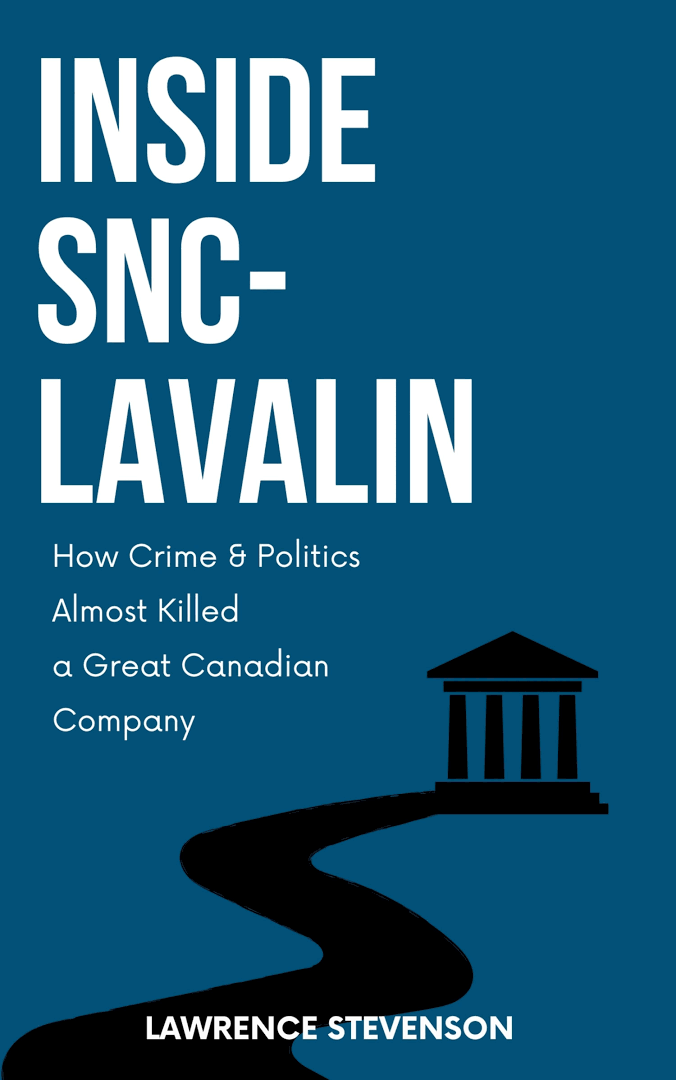
Book Review – Inside SNC – Lavalin
By Lawrence (Larry) Stevenson
Published by Sutherland House Books
160 pp. $27.95
Review by 12570 Mike Kennedy
All throughout his life, 11721 Larry Stevenson has never been one to shrink from a challenge. As a cadet, he excelled in the military college system, graduating from RMC as CWC of the Class of 1978 and winning the Sword of Honour for his achievements. After commissioning, he served with the PPCLI and later in the Canadian Airborne Regiment. After his service obligation, Stevenson earned an MBA from the Harvard Business School and subsequently pursued a remarkably successful business career, first as a partner with the international strategic consulting firm Bain and Company, and subsequently as the founder and CEO of the Chapters chain of bookstores.
It was not until many years later, however, that Stevenson would confront what was arguably the most difficult challenge of his career. As director and subsequently Chairman of the global engineering giant SNC Lavalin, his leadership played a pivotal role in guiding the organization through one of the worst ethical crises ever faced by a Canadian company. In a newly published book, Stevenson recounts his experiences and offers his views on some guiding principles for effective corporate governance.
Stevenson was first invited to join the SNC Lavalin board in 1999, when he was CEO of Chapters and still only in his early 40’s. At the time, the company was led by Jacques Lamarre, who served as CEO for 13 years and built was a corporate powerhouse that not only a shining star of the Quebec business community, but also one of a few Canadian companies that were global leaders in their respective fields. Under Lamarre’s leadership, SNC Lavalin was an entrepreneurial organization with a freewheeling culture, and one wherein leaders of individual business units were encouraged to run their operations on their own, with minimal oversight from head office. Stevenson makes the point that this lack of centralized control was one of the main contributing factors to the company’s subsequent difficulties.
The first sign that something was amiss emerged in late 2011, when a Canadian woman named Cynthia Vanier was arrested in Mexico. Ms. Vanier claimed that she had been in Mexico undertaking research on behalf of SNC Lavalin, but Mexican authorities alleged that in reality she was involved in a plot to smuggle Saadi Gaddafi, the son of the recently assassinated Libyan dictator Muammar Gaddafi, into Mexico and secure a safe house for him. The situation became even more bizarre when Stéphane Roy, an executive with SNC Lavalin, was arrested in Mexico City on charges relating to the Gaddafi. At the time, Mexico was a country in which SNC Lavalin did very little business, and not surprisingly Stevenson and his fellow directors were quite perplexed about what was going on.
It wasn’t long before evidence of a much more sinister situation quickly began to emerge. It soon came to light that Roy had arranged for SNC Lavalin to pay Vanier a total of $1.8 million, money that was intended to pay for private jets to get Saadi Gaddafi out of Libya and hire mercenaries to project him. Even worse, these revelations were only the tip of the iceberg. It would eventually be determined that possibly as much as $139 million of SNC Lavalin’s funds had been misappropriated; much of the money had been sent to Swiss bank accounts that could not be traced.
The principal culprit behind this massive fraud was Riadh Ben Aissa, who at the time was one of SNC Lavalin’s most powerful executives. A native of Tunisia, Ben Aissa had joined the company in 1985 after earning his MBA from the University of Ottawa, in the years that followed he made a meteoric ascent though the executive ranks. In 1988, when he was only 30 years of age, Ben Aissa was appointed regional director for the Middle East and North Africa, and over the next several years he made his name by spearheading SNC Lavalin’s largest projects in that part of the world.
Seemingly in recognition of Ben Aissa’s obvious abilities, CEO Jacques Lamarre granted him an enormous amount of freedom. This would eventually turn out to be a near fatal mistake. As the members of the board began to take a closer look at Ben Aissa’s activities, they would soon discover that he was using SNC Lavalin’s money to enrich himself and his family to the tune of millions of dollars.
Faced with a rapidly unfolding crisis, Stevenson and his fellow directors were forced to take action. The company quickly parted ways with several key people, including Pierre Duhaime, who by that time had succeeded Jacques Lamarre as CEO, and Stéphane Roy, the executive who had been arrested in Mexico. To help right the ship, an interim CEO was appointed; this was Ian Bourne, a veteran member of the board who had previously followed highly successful career at General Electric and who was known and respected for his impeccable standards of integrity. Immediately after assuming the CEO role Bourne set to work tightening up centralized control and implanting rigorous new standards of conduct. Efforts to clean up the mess would further continue under the leadership of Bob Card, who joined SNC Lavalin as the new permanent CEO in late 2012.
Nevertheless, troubles continued to mount. Even though SNC Lavalin had already handed over the appropriate files to the RCMP and the Quebec Provincial Police, in April of 2012 the company received an unwelcome surprise when the Mounties showed up at head office to conduct an unexpected raid. Charges would eventually be laid against Pierre Duhaime and Riadah Ben Aissa, both of who had already been terminated. The raid was widely covered by the media, and the fallout that resulted was dramatic. SNC Lavalin’s share price dropped from $51 at the start of 2012 to $35 by the summer of that year, wiping out billions of dollars in shareholder value and taking a painful bite out of the incomes of many Quebec pensioners. Finally, in early 2015 the RCMP and the Public Prosecution Service of Canada laid charges of fraud and corruption against SNC Lavalin and two of its subsidiary companies.
Shortly after the charges were laid, Stevenson was asked to step into the Chairman’s role. One of his first tasks was to help recruit a successor to the incumbent CEO, Bob Card. But he also had to deal with the thornier issue of the criminal charges that were hanging over the company’s head. Had SNC Lavalin pleaded guilty to these charges, the company would have been barred from bidding on government contracts, an outcome that would almost certainly have precipitated its demise.
Faced with this dilemma, Stevenson and his colleagues concluded that the only way out of the quagmire would be for SNC Lavalin to seek a Delayed Prosecution Agreement (DPA). A DPA is basically an arrangement wherein companies charged with criminal conduct can seek to delay prosecution in exchange for a commitment to meet a lengthy list of conditions intended to compel them to clean up their internal problems and thereby remain economically viable. Over the years DPA agreements have been negotiated with various governments by many leading global companies such as General Electric, Volkswagen, Dupont, and Microsoft.
DPAs are a widely accepted practice in jurisdictions such as the United States and the United Kingdom, but unfortunately at the time of SNC Lavalin’s woes no such provisions existed in Canada. Accordingly, the company’s board and management lobbied vigorously for Ottawa to pass the legislation that would be required. Their argument was that a DPA agreement would permit SNC Lavalin to avoid a lengthy and hugely expensive legal process, give the company time to rectify its internal problems, and in the process, ultimately protect thousands of Canadian jobs.
Eventually these efforts proved to be successful, and in early 2018 the Liberal Government of Justin Trudeau approved amendments to the Criminal Code to permit DPAs that would be known as “remediation agreements” in Canada. The resulting euphoria, however, proved to be short lived. In September 2018, SNC Lavalin was informed that the Minister of Justice, Jody Wilson-Raybould, had decided not to negotiate a remediation agreement with the company. This decision was based on the advice of the Director of Public Prosecutions, and little justification was offered for it.
This latest chapter in the saga injected a new degree of tension into the already difficult relationship between Wilson-Raybould and Prime Minister Justin Trudeau, with the result that Wilson-Raybould was ousted as Justice Minister in January 2019. A month later, she quit the Cabinet and her departure soon precipitated several other high-profile resignations. The Wilson-Raybould affair was the subject of intense media scrutiny, and Trudeau was later criticized for having contravened Section 9 of the Conflict of Interest Act.
In the final analysis, both Trudeau and SNC Lavalin managed to weather the storm. In October 2019 Trudeau managed to win re-election for a second mandate, albeit this time with a minority government. At the end of that year, a division SNC Lavalin pleaded guilty to fraud, agreed to pay a $280 million fine, and was placed on a three-year probation period. Stevenson notes that while this outcome was far from ideal, it was one that ensured the company averted what could otherwise have easily been a disastrous alternative.
SNC Lavalin had been saved, but had paid an enormous price in the process. In the wake of the scandal that had first erupted in 2011, the company shed some 9,000 jobs and lost billions of dollars in shareholder value. By the time the dust had settled, only a handful of the organization’s top 120 managers were still on the payroll.
As for the bad actors whose actions precipitated this corporate tragedy, none of them would eventually suffer the consequences that they probably deserved. Stevenson laments the fact that not one of them served a single day in a Canadian jail. Riadh Ben Assia was eventually detained in Switzerland, where he made plea bargain that saw him spend a brief period of time in prison and agree to repay millions of the dollars he had stolen. (It remains unclear how much was actually repaid). Pierre Duhaime, the ex-CEO, was arrested in late 2014 and five years later pleaded guilty to various charges. He escaped with a $25,000 fine, 20 months of house arrest, and an order to perform community service.
Undoubtedly the luckiest of all was Stéphane Roy, the executive whose arrest in Mexico in 2011 was one of the opening acts in the start of this whole sordid affair. He was originally charged in 2014 with fraud and corruption, but in February 2019 a Quebec judge stayed the charges, stating that there had been unreasonable delays in bringing the case to trial.
Inside SNC Lavalin is a fascinating, highly readable account of the challenges Stevenson and his colleagues faced in navigating through the perils of a potentially explosive situation that brought a once-proud and highly respected Canadian company to the very brink of extinction. Throughout the book, Stevenson highlights the importance of his experiences in military college during his formative years, and discusses how the principles of “Truth, Duty, Valour” have served as the foundation of the moral compass that has guided him throughout his career ever since. This book is a must-read for anyone in a position of leadership in Corporate Canada, and it is also one that will be enjoyed and appreciated by all Ex-Cadets.