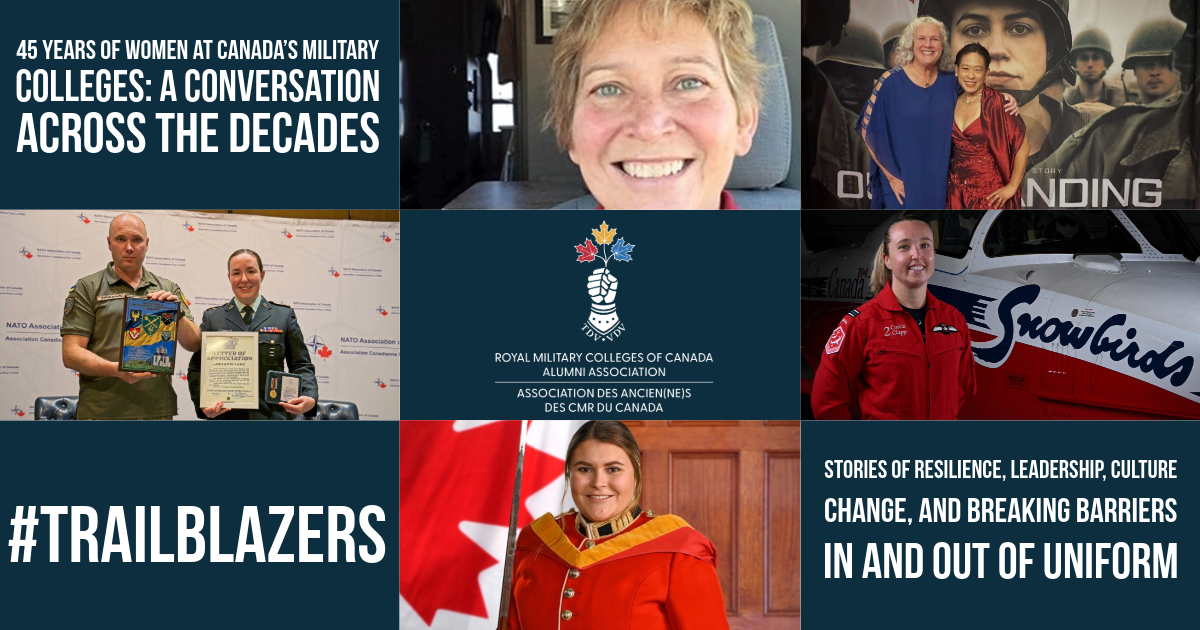
The Trailblazer Podcast celebrates the accomplishments and milestones of notable alumni of Canada’s Military Colleges and provides a platform for them to share their stories and contribute to building future leaders for Canada and the world.
To mark the 45th anniversary of women joining the Canadian Military Colleges, we convened an extraordinary panel of alumnae—each representing a different decade of progress since those first pioneering women arrived in 1980. Their careers span logistics, intelligence, combat engineering, aviation, and international operations. Their reflections offer a rare, decade-by-decade portrait of how life at the Colleges—and within the Canadian Armed Forces—has evolved.
The earliest experiences belong to Colleen Hagerty, who entered RMC in 1981 as part of the second class of women. Her memories are stark. With no senior women and only a handful of female peers, she often felt alone. The institution was still visibly adjusting to its new reality. At the time, an openly shouted cadet chant proclaimed the “last class with balls”—a reminder of how unwelcome women could feel.
Yet Hagerty stayed, driven by a sense that someone needed to open the door for those who would follow. Her story grounds the conversation in what the earliest trailblazing truly required: stamina, resilience, and conviction.
By the 1990s, when Major Melissa Olegario arrived at RMC St-Jean, the landscape had shifted. Female cadets were still few, but no longer rarities. Olegario recalls feeling like an equal on campus—an experience that stood in contrast to the broader CAF, where she later encountered sexism and racial bias. Her career, which spanned the Infantry, Intelligence, and UN operations, reflects a commitment to empowerment and culture change built through persistence and integrity.
The 2000s brought further transformation. Lieutenant-Colonel Melanie Lake, who arrived at RMC as a 17-year-old with no military background, found a deeply supportive cohort of women whose friendships have endured throughout combat deployments and demanding leadership appointments. Her generation was profoundly shaped by operational realities—she was in fourth year when the 9/11 attacks occurred and soon found herself deployed to Afghanistan. Later, she commanded Operation UNIFIER in Ukraine, earning the Meritorious Service Medal.
Her reflections highlight not only the weight of responsibility, but the importance of leadership grounded in empathy—a style once criticized but increasingly recognised as essential to institutional renewal.
For Captain Caitie Clapp, who graduated a few years later, RMC was defined by camaraderie and possibility. She never thought to count the number of women in her class—there were enough that she didn’t have to. Now a Snowbirds pilot flying the Number Two jet, she speaks candidly about the role models she hopes to represent for the next generation. Her career has not been linear, but her philosophy—“fail early and fail often”—captures the spirit of the modern Canadian officer.
Rounding out the panel is Lieutenant Valerie Cunningham-Reimann, representing the 2020s. Her experience at RMC was marked by choice, community, and momentum. From varsity rugby to gender-focused leadership initiatives, she embraced every opportunity. Now a Combat Engineer Officer recently returned from Operation IMPACT in Jordan, she offers a glimpse into what today’s most promising young leaders are already accomplishing on the world stage.
Cunningham-Reimann’s reflections reveal a College experience that is increasingly supportive and diverse—though still shaped by the challenges facing women in combat-arms trades.
Together, these five women trace a powerful arc across four and a half decades of service. Their collective story shows that progress has not been accidental. It has come from women who stayed, who excelled, who challenged outdated assumptions, and who refused to let their experiences end with them.
They are candid about how far things have come—greater representation, stronger communities, and leaders who now understand the value of different perspectives. But they also acknowledge the work that remains: ensuring inclusion is consistent, not conditional; advancing culture change in all environments; and supporting the next generation with mentorship, visibility, and honest conversations.
This special Trailblazer episode is more than a retrospective. It is a reminder that leadership evolves, culture shifts, and institutions grow stronger when people push from within.
Colleen’s persistence in the early ’80s paved the way for Melissa’s sense of equality in the ’90s. Melissa’s advocacy helped shape the environment where Melanie could lead with empathy in the 2000s. Melanie’s operational experience and leadership opened space for Caitie’s achievements in the air. And Caitie’s visibility as a Snowbird helps inspire cadets like Valerie—who, in turn, is already forging the next chapter of service.
This episode is a rare multi-generational dialogue filled with humour, candour, hard-earned wisdom, and heartfelt advice for today’s cadets—especially young women who wonder whether they belong at Canada’s Military Colleges or in the CAF.
And these Trailblazers’ response is clear:
You do. Your voice matters. And the story is still being written.
Listen to the full Trailblazer Podcast episode to hear their stories in their own voices.